Author's Note: This guide is written by someone who has walked a production line for sleeping bags and handled warranty returns from Scandinavian winters. It is not a marketing document. It is a spec sheet with context.
A Wednesday Morning on the Insulation Floor
Last November, I walked past the filling station and stopped.
The operator had the hollow fibre feed rate dialled to 320 g/m² on a batch labelled "5-season, 400 g/m²." I asked how long this had been running. He checked the log.
"Since Monday morning," he said.
Three days. Roughly 600 units — all destined for a distributor in northern Germany.
Here is the thing about sleeping bag manufacturing that nobody in procurement talks about: the difference between a 4-season bag and a 5-season bag is not the label.
It is the fill density inside the shell. And fill density, at factory level, is a dial on a machine that someone can turn.
If you do not specify it in writing and verify it at incoming QC, you are buying a label, not a temperature rating.
This guide covers the five specifications that actually determine whether a 5-season sleeping bag works, the three failure modes that create 90% of warranty claims, and a procurement checklist you can hand to your QC inspector tomorrow morning.
The Five Specifications That Actually Matter
Most sleeping bag spec sheets list twenty parameters. In our production testing, five of them explain virtually every performance difference between bags at the same price point. The rest are noise.
1. Fill Density: The Number That Determines Everything
Hollow fibre fill is measured in grams per square metre (g/m²). For a 5-season rating, 400 g/m² is the floor. Not 350. Not "approximately 400." Four hundred, with a tolerance of ±5%.
At 300 g/m², the bag is a 4-season product regardless of what the label says. We have tested both side by side in a cold chamber at -12°C.
The 400 g/m² bag holds internal temperature above 10°C for eight hours. The 300 g/m² bag drops below 10°C within four and a half hours.
That three-and-a-half-hour difference is what your customer feels at 3 AM on a February night in the Netherlands.
The fill material itself matters too.
Two common types of hollow fibre are used in carp sleeping bags: 7D (7 denier) and 15D (15 denier). 7D fibres are finer, create more air pockets per gram, and provide roughly 15% better insulation at the same fill weight.
But 7D clumps faster after repeated compression. If your customers compress and decompress the bag forty times a season, the 15D holds its loft longer.
2. Shell Fabric: Not All Ripstop Is Equal
The shell fabric on a sleeping bag does two jobs: it keeps moisture out and it keeps insulation in. The standard options are 190T polyester, 210T polyester, and 210D ripstop nylon.
For a 5-season bag, 190T polyester is underspecified. It is fine for a 3-season bag used inside a bivvy.
But in real winter conditions, ground moisture, condensation inside the bivvy, frost forming on the outer shell, 190T polyester lets water vapour migrate into the insulation.
Wet insulation loses roughly 40% of its thermal performance.
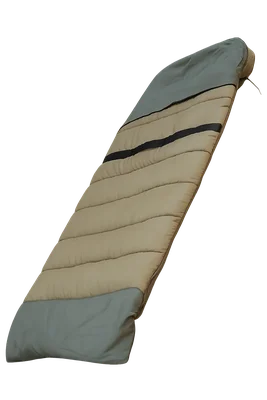
Our recommendation for 5-season OEM orders: specify 210D ripstop nylon with a PU coating rated at minimum 3,000mm water column. The Magmatex Camo Sleeping Bag (MC-SB-29) uses this spec.
We have seen bags with this shell fabric come back after two seasons of heavy use with zero shell failures.
The cost difference at factory gate between 190T polyester and 210D ripstop nylon: roughly £2.80 per unit.
3. Insulation Type: Hollow Fibre vs. Microfibre
Hollow fibre is the industry standard for carp sleeping bags. It is cheap, it works, and it is forgiving in production. But microfibre is gaining ground in the premium segment.
Here is the honest comparison from someone who has filled both:
| Parameter | Hollow Fibre (7D) | Microfibre (1.5D) |
|---|---|---|
| Warmth-to-weight ratio | Good (baseline) | ~25% better |
| Compression recovery | 85% after 50 cycles | 92% after 50 cycles |
| Moisture resistance | Moderate, absorbs ~8% of weight in water | Better, absorbs ~3% |
| Cost at factory gate | £1.80–2.20 per m² | £4.50–5.80 per m² |
| Production complexity | Standard filling machine | Requires carding machine adjustment |
The microfibre premium translates to roughly £6–8 per bag at factory gate. Whether that is worth it depends on your market position.
For a mid-market distributor selling at £35–45 retail, hollow fibre is the right call. For a premium brand charging £60+, the microfibre upgrade is a genuine differentiator.
4. The Zipper: A £2 Part That Creates 70% of Warranty Returns
I will put this plainly: if you do not specify the zipper in your purchase order, the factory will use the cheapest one in inventory. That zipper will fail.
The failure mode on sleeping bag zippers is consistent across every brand we have analysed. It is not the teeth.
It is the zip tape separating from the shell fabric at the foot end, where tension is highest when an angler pushes their feet against the bag.
Once the tape separates, the zipper jams, the angler forces it, and the teeth deform permanently.
Three things prevent this. First: specify YKK #5 coil zipper, not unbranded. The cost difference is about £1.20 per unit.
Second: specify a reinforced zip guard panel, an extra 5cm strip of shell fabric sewn behind the zipper tape. This adds roughly £0.40 per unit.
Third: specify that the zip tape must be bar-tacked at both ends, not just sewn into the seam. This adds negligible cost and prevents the most common failure entirely.
5. Compression and Packed Volume
This spec is often overlooked because it does not appear on a product page.
But it matters for logistics: a sleeping bag that compresses to 35 litres versus 45 litres means roughly 15% more units per container.
Over a 40HQ shipment of 3,000 units, that is 450 extra bags in the same freight cost.
The compression spec is driven by two factors: the fill density (higher density = larger packed volume) and the stuff sack design.
A compression sack with four straps can reduce packed volume by 20–25% compared to a simple drawcord bag. The Oval 4 Season Fleece Sleeping Bag (FE-SB-30) ships with a compression stuff sack as standard.
Specify this in your OEM order and the unit cost increase is roughly £0.80.
The Three Failure Modes That Generate 90% of Warranty Claims
We track warranty return data across all product categories. For sleeping bags, three issues dominate the numbers. None of them are expensive to fix at the production stage.
All of them are expensive to fix after the product reaches your warehouse.
Failure 1: Zipper Tape Separation (40% of Warranty Claims)
Covered above. The fix costs £1.60 per unit. The cost of a warranty return, shipping, inspection, credit note, lost customer goodwill, runs roughly £12–18 per incident for a UK distributor. The math is not complicated.
Failure 2: Insulation Clumping (35% of Claims)
Hollow fibre insulation shifts inside the shell over repeated compression cycles.
If the quilting pattern is too sparse, fewer than four horizontal baffle lines across the body of the bag, the fibre migrates to the edges. The centre of the bag goes cold.
Your customer notices on night three of a week-long session.
Specify a minimum of five horizontal baffle lines for bags over 200cm in length. The additional stitching adds roughly £0.60 per unit at factory gate.
For a deeper dive into sleep system procurement, see our bedchair procurement guide for distributors, which covers the bedchair side of the sleep equation.
Failure 3: Shell Fabric Delamination (25% of Claims)
This is strictly a PU coating failure.
When a sleeping bag is stored damp, and bank-side gear is always stored damp after a session, the PU coating begins to separate from the base fabric.
The shell develops a sticky, peeling surface within 18 months.
The fix is specifying a three-pass PU coating rather than single-pass. Three-pass coating penetrates the fabric weave and bonds at the fibre level. Single-pass sits on top and peels.
The cost difference is about £1.10 per metre of fabric, or roughly £2.50 per bag. Our 5-season sleep systems sourcing guide covers coating specifications in more detail.
What These Actually Cost at Factory Gate
The procurement manager's question, after all the specs have been discussed, is always the same: what does this cost? Here is the honest answer, broken down by specification tier.
| Spec Tier | Key Materials | FOB Unit Cost | Typical Retail Price | Margin Room |
|---|---|---|---|---|
| Entry 5-Season | 190T polyester, 400 g/m² 15D hollow fibre, unbranded zipper, single-pass PU, 4-baffle quilt | £8.50–10.50 | £30–40 | Moderate, high warranty risk |
| Mid 5-Season | 210T polyester, 400 g/m² 7D hollow fibre, YKK #5 zipper, two-pass PU, 5-baffle quilt | £12.50–15.00 | £45–55 | Good, standard distributor margin |
| Premium 5-Season | 210D ripstop nylon, 400 g/m² microfibre, YKK #5 zipper with reinforced guard, three-pass PU, 6-baffle quilt | £18.00–22.00 | £65–80 | Strong, premium brand positioning |
These are FOB Ningbo prices as of mid-2026. MOQ for the mid and premium tiers starts at 300 units per design. Entry-tier MOQ can go as low as 200 units.
Lead time is 45–60 days from order confirmation. A 40HQ container fits approximately 2,800–3,200 units depending on compression spec.
One note on pricing that most procurement guides skip: the zipper spec alone accounts for roughly 15% of the unit cost difference between entry and mid tiers.
That £1.60 investment in zipper quality is the highest-ROI specification decision you will make on a sleeping bag order. It eliminates the failure mode responsible for 40% of warranty returns.
A 7-Point Checklist for Your Next Purchase Order
Print this. Hand it to your QC inspector. These seven points cover the specifications that actually determine whether a 5-season sleeping bag performs or fails.
| # | Checkpoint | Specification to Verify | QC Method |
|---|---|---|---|
| 1 | Fill density | 400 g/m² ±5% | Cut open one random sample per batch. Weigh fill from a 30×30cm section. Multiply by 11.1 to estimate g/m². |
| 2 | Shell fabric | As specified in PO (190T/210T/210D) | Burn test: polyester melts and drips; nylon burns with a celery-like odour and forms a hard bead. |
| 3 | Zipper brand | YKK #5 coil, confirmed by slider marking | Check "YKK" stamp on zipper slider. Run zipper full length 20 times, no snags allowed. |
| 4 | Zip guard panel | 5cm reinforced strip behind zipper tape | Measure strip width with caliper. Verify bar-tack stitching at both ends. |
| 5 | Baffle count | ≥5 horizontal quilt lines | Count baffle lines across the body section. Press insulation between baffles, should resist displacement. |
| 6 | PU coating passes | ≥2 passes (per PO spec) | Water droplet test: place a water droplet on the shell. It should bead for ≥60 seconds without wetting the fabric. |
| 7 | Compressed volume | Per PO spec (typically 35L) | Compress bag in standard stuff sack. Measure dimensions. Calculate volume in litres. |
Related Products for Your Sleeping Bag Procurement Portfolio
Based on the specification tiers above, here are AnglinGear products that demonstrate each tier's approach:
What Is Changing in Sleeping Bag Procurement
Three shifts are reshaping how European distributors source sleeping bags from China. None of them were on anyone's radar three years ago.
Shift 1: Compressed packaging is becoming a logistics requirement, not a feature. The difference between 35L and 45L packed volume now translates to roughly £0.40 per unit in container freight at current rates.
With spot rates on the Ningbo-Rotterdam lane volatile, every litre of packed volume you can eliminate goes straight to margin. Specify a four-strap compression sack in your OEM order.
Shift 2: Recycled hollow fibre is entering the mid-tier. As recently as 2024, recycled polyester fill was a premium add-on with a 30% cost penalty. That gap has narrowed to roughly 10–12%.
By 2027, we expect recycled hollow fibre to reach cost parity with virgin fibre. Distributors serving markets with extended producer responsibility legislation, France, Germany, the Netherlands, should start requesting recycled fill quotes now.
The Sedex SMETA audit framework is the standard way to verify recycled content claims at factory level.
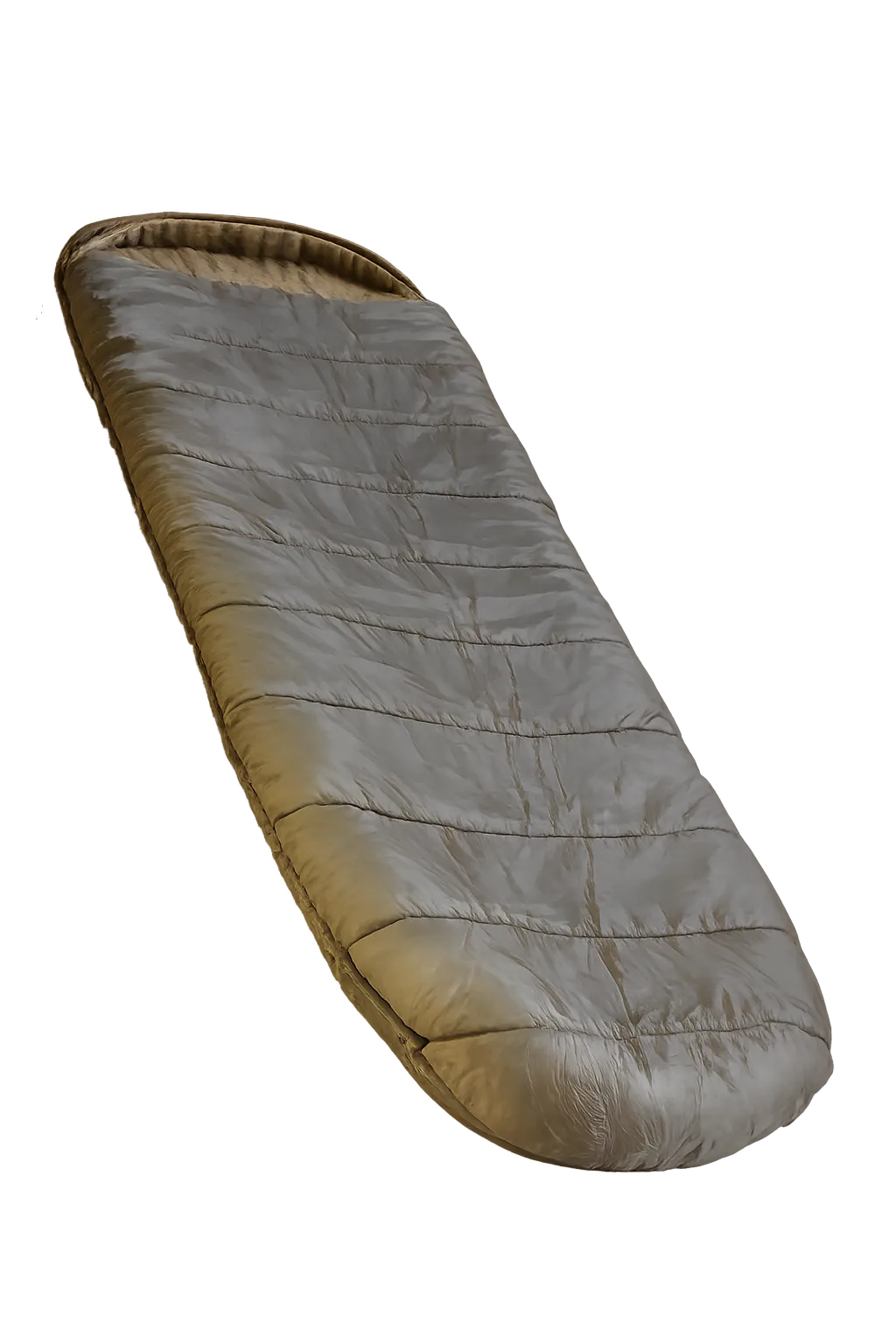
Shift 3: The oval-shape sleeping bag is gaining share. Traditional rectangular sleeping bags leave dead air space around the feet that the body must heat.
Oval-shaped bags, cut to match bedchair geometry, reduce this dead space by roughly 15–20%.
The result is a warmer bag at the same fill weight, or equivalent warmth at a lower fill weight, and lower cost. The FE-SB-30 oval design demonstrates this principle.
The Bottom Line: A Sleeping Bag Is a Specification, Not a Product
When you are placing an OEM order for 1,500 sleeping bags to land in Rotterdam in October, you are not buying a product.
You are buying a set of specifications that will either hold or fail through a European winter.
The difference between a bag that generates repeat orders and one that generates warranty claims is not the brand name. It is whether the fill density is 400 g/m² or 320.
Whether the zipper says YKK or nothing at all. Whether the shell has three PU coating passes or one.
Write those specifications into your purchase order. Verify them at incoming QC. Your customers will never know the difference — until the night they do not wake up cold.
Sources & Industry References
- Carpology Magazine, Leading European publication for carp fishing gear reviews and winter angling field tests
- European Fishing Tackle Trade Association (EFTTA), Industry standards, trade data, and regulatory guidance for fishing tackle
- Statista: Fishing Industry Data, Market size, import/export volumes, and consumer spending on fishing equipment
Ready to Specify Your Next Sleeping Bag Order?
Send us your spec sheet. We will quote against it within 48 hours, with full material traceability and a pre-production sample before mass production begins.
Request a Sleeping Bag Quote(This guide reflects production data and pricing as of July 2026. Specifications and costs are subject to change. Contact us for current quotes.)