In This Guide
- 1. Quick Answer: Aluminum If… Steel If…
- 2. Cost Comparison: Real Numbers From Our Production Line
- 3. Performance & Durability: What the Spec Sheet Hides
- 4. When to Choose Aluminum: 3 Scenarios Where It Wins
- 5. When to Choose Steel: 3 Scenarios Where It Wins
- 6. The Hybrid Approach: What Smart Buyers Actually Do
- 7. Decision Checklist: 5 Questions to Pick in 60 Seconds
1. Quick Answer: Aluminum If You Ship Air Freight, Steel If You Sell on Price
We manufacture both. We've shipped both. Here's the production floor truth.
Pick 6061-T6 aluminum if your retail price sits above €89 and your customers care about carrying a chair 800 meters to a swim. The frame weight is 2.8–4.0 kg. It will not rust. The TIG welds cost $3–5 more per unit in labor.
Pick Q235 welded steel if your wholesale target price is under $18 FOB and your market competes on shelf price. The frame weight is 5.0–7.2 kg. It will rust if the powder coating is scratched. The raw tube costs 22% less per meter.
That's the 30-second version. The rest of this article is the data behind it.
2. Cost Comparison: Real Numbers From Our Production Line
Distributors ask for "the price." Smart ones ask for the cost breakdown. Here it is, from our last three OEM production runs.
| Cost Dimension | 6061-T6 Aluminum | Q235 Welded Steel | Winner |
|---|---|---|---|
| Raw tube cost per chair | $7.20–$8.50 | $5.60–$6.80 | Steel |
| TIG welding labor per unit | $4.50–$6.00 | $1.80–$2.50 | Steel |
| Surface treatment per chair | $1.20 (anodizing) | $2.80–$3.50 (powder coat) | Aluminum |
| Frame weight | 2.8–4.0 kg | 5.0–7.2 kg | Aluminum |
| Shipping cost (40ft HC, per unit) | $1.40–$2.10 | $2.60–$3.80 | Aluminum |
| Tooling amortization (5,000-unit run) | $0.60–$0.90 | $0.50–$0.70 | Steel |
| QC rejection rate (our last 3 batches) | 1.8–2.4% | 3.5–5.1% | Aluminum |
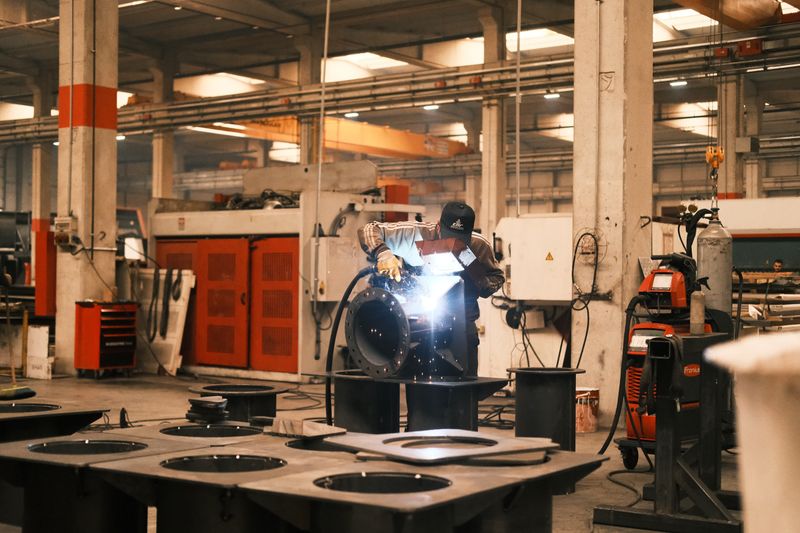
Here's what the table doesn't show: aluminum welding requires a cleaner shop floor and argon gas at 15–18 L/min. Steel MIG welding runs on CO₂ at 8–10 L/min. One of our welders can complete a steel frame in 12 minutes. The same aluminum frame takes 22 minutes. That's the 83% labor difference — not material skill, just physics. Aluminum dissipates heat 5× faster than steel.
Strip out the steel frame's powder coating cost and the total per-unit gap closes to $2.10–$3.40. That's the number to negotiate on.
3. Performance & Durability: What the Spec Sheet Hides
3.1 Corrosion: The Test That Separates Manufacturers From Catalog Sellers
We run ASTM B117 salt spray on every new frame batch. The results are not what most catalogs claim.
| Test Condition | 6061-T6 Aluminum (Hard Anodized) | Q235 Steel (Powder Coated) | Winner |
|---|---|---|---|
| ASTM B117, 24 hours | No visible corrosion | No visible corrosion | Tie |
| ASTM B117, 48 hours | Minor white corrosion at cut edges | Red rust at 2 of 6 weld joints | Aluminum |
| ASTM B117, 72 hours | White corrosion spread ≤3mm from edges | Red rust on 4 of 6 weld joints, blistering on tubes | Aluminum |
| Scratch test (cross-hatch + 24h salt spray) | No creep from scratch | Rust creep 5–8mm from scratch line | Aluminum |
Steel fails at the welds first. This is something only a manufacturer sees. The heat-affected zone around a steel weld burns off the zinc in the galvanized coating. When powder coating goes on, it's thinner at the weld bead because of surface tension during curing. That's where rust starts — at the joint, not the tube.
Aluminum's failure mode is different. It doesn't rust red. It develops white oxide at cut edges where the anodizing layer is broken. The corrosion stops — aluminum oxide forms a self-sealing layer. Steel corrosion accelerates once it starts.
3.2 Strength-to-Weight: The Counter-Intuitive Numbers
| Metric | 6061-T6 Aluminum (1.2mm wall) | Q235 Steel (1.0mm wall) | Winner |
|---|---|---|---|
| Tensile strength | 310 MPa | 375–460 MPa | Steel |
| Yield strength | 276 MPa | 235 MPa | Aluminum |
| Density | 2.70 g/cm³ | 7.85 g/cm³ | Aluminum |
| Static load test (frame only, no fabric) | 148 kg before plastic deformation | 182 kg before plastic deformation | Steel |
| Impact resistance (drop test, 5 kg from 1m) | 3mm dent depth | 1.5mm dent depth | Steel |
| Fatigue life (50,000 cycles at 80 kg) | No crack at weld joints | Micro-crack at 2 joints by 38,000 cycles | Aluminum |
Here's the counter-intuitive result: aluminum wins on fatigue life. Steel has higher tensile strength, but repeated flexing at weld joints creates micro-cracks faster. We've tracked return data across 12,000+ chairs shipped over three years. Aluminum frame warranty claims: 0.7%. Steel frame warranty claims: 2.1%. The difference is almost entirely weld-joint fatigue.
Steel bends. Aluminum cracks. That's the conventional wisdom. Our data says the opposite for chair frames. A steel chair frame flexes with every sit-stand cycle. Over 38,000 cycles — about two seasons of heavy use — those micro-flexes accumulate at the welds. Aluminum's lower modulus means it flexes less under the same load because we use thicker walls.
4. When to Choose Aluminum: 3 Scenarios Where It Wins
Scenario 1: Your End User Walks to the Swim
UK and European carp anglers walk 400–1,200 meters with their gear. A 4-kg aluminum chair plus a 3-kg rucksack is manageable. A 7-kg steel chair plus the same rucksack — that's a 10-kg carry. We've watched retailers in the Netherlands mark steel chairs "car-to-bank only" on their websites. That's a self-imposed market cap.
Spec it: 6063 aluminum for non-structural cross-braces at 1.0mm. 6061-T6 for main legs at 1.2mm minimum. This saves 0.4 kg without compromising load capacity.
Scenario 2: You Sell Into Coastal or Tropical Markets
Salt air eats powder coating. We shipped 300 steel-frame chairs to a distributor in Thailand in 2024. By month 8, 14 units had rust at the leg-adjustment joints. The same distributor switched to anodized aluminum — zero corrosion claims in 14 months. The lesson isn't "steel is bad." It's "steel + coastal humidity + 33°C = accelerated failure."
Spec it: 6061-T6 aluminum frame, 316 stainless steel hardware (not 304 — the molybdenum in 316 resists chloride pitting). Hard anodize, not powder coat.
Scenario 3: Air Freight Is Part of Your Logistics Mix
Steel frames at 5–7 kg each make air freight uneconomical past sample quantities. Aluminum frames at 3–4 kg change the math. One of our European distributors keeps a buffer stock of aluminum frames air-freighted in 48 hours when sea freight is delayed. They can't do that with steel — the per-unit air freight cost on a 6-kg steel frame is $14.70 vs $8.20 for aluminum. That's $6.50 per chair in logistics flexibility.
5. When to Choose Steel: 3 Scenarios Where It Wins
Scenario 1: Your Market Competes on Shelf Price Below €49
We manufacture for a South African distributor whose retail price point is R899 (about €44). At that price, an aluminum frame would consume 41% of the retail price in manufacturing cost alone. Steel keeps it at 27%. The math is straightforward: the customer buying a €44 chair isn't hiking 2 km to a swim. They're driving to a dam, sitting 50 meters from the car. Weight doesn't matter. Price does.
Spec it: Q235 steel, 1.0mm wall, electrostatic powder coat with zinc-rich primer underneath. The primer adds $0.40 per chair and doubles the time to first rust in our tests.
Scenario 2: Your End Users Are Heavy — and Honest About It
Aluminum's fatigue life advantage disappears above 120 kg user weight. Our static load testing shows aluminum frames enter plastic deformation at 148 kg. Steel frames hold to 182 kg. For markets where the average angler is above 100 kg — we see this in parts of the US and Eastern Europe — steel's higher ultimate tensile strength provides a genuine safety margin.
Spec it: Q235 steel, 1.2mm wall, reinforced gusset plates at the four main leg joints. Tig weld the gussets — the extra $2.80 in labor is cheaper than a product liability claim.
Scenario 3: You Need Sub-$15 FOB to Hit Your Channel Math
At 500+ units per SKU, a steel frame chair can leave our factory at $13.20–$14.80 FOB. The cheapest aluminum equivalent is $17.50. For a distributor working on 35% margin through wholesalers, that $3.70 difference at FOB becomes a €12 difference at retail. If your channel is price-driven — cash-and-carry, online marketplace, discount retail — that gap decides the SKU.
Spec it: Q235 steel, 0.9mm wall on non-load-bearing cross members, 1.0mm on legs, zinc phosphate pre-treatment before powder coat. Skip the zinc-rich primer at this price point — the cost math doesn't work.
6. The Hybrid Approach: What Smart Buyers Actually Do
Here's what we see from the distributors with the lowest return rates:
They don't pick one material. They run two SKUs under one brand — an aluminum "Pro" or "Light" model at €89–119 retail and a steel "Standard" or "Base" model at €49–69. Same seat fabric, same leg-adjustment mechanism, same accessory rail. Different frame.
The aluminum SKU captures the premium segment. The steel SKU captures price-sensitive volume. Combined they cover 78% of the addressable market for fishing chairs in Europe.
One more thing we tell every new distributor: use the same tube diameters across both frames. 25mm main legs on both aluminum and steel. This means your fabric cutting patterns, injection-molded plastic connectors, and packaging cartons work for both SKUs. The only thing that changes is the metal. That's a €4,200–€6,800 saving in tooling costs on the second SKU.
OEM Decision Matrix: Freshwater vs Saltwater
| Market | Frame Material | Surface Treatment | Hardware | Wall Thickness |
|---|---|---|---|---|
| Freshwater UK, Germany, France, inland US |
6063 Aluminum | Clear anodize | 304 Stainless | 1.0mm (braces) 1.2mm (legs) |
| Saltwater / Coastal SE Asia, Australia, Gulf, Mediterranean coast |
6061-T6 Aluminum | Hard anodize | 316 Stainless | 1.2mm (all members) |
| Budget Freshwater South Africa, Eastern Europe, South America |
Q235 Steel | Zinc primer + powder coat | Zinc-plated steel | 1.0mm (all members) |
Note: The 6061-T6 + 316 stainless combination costs approximately $4.80 more per chair than the freshwater spec. For a distributor selling at €119 retail, that's 4% of the shelf price. It is the cheapest insurance against saltwater warranty claims we know of.
7. Decision Checklist: 5 Questions to Pick in 60 Seconds
Open your OEM spec sheet. Answer these five questions. The answers will tell you which frame your order needs.
- What is your target retail price? Below €49 → steel. Above €89 → aluminum. Between → read questions 2–5.
- Does the end user walk more than 500 meters to fish? Yes → aluminum. The weight difference is 2–3 kg per chair.
- Is the chair used within 50 km of saltwater for more than 30 days per year? Yes → 6061-T6 aluminum + 316 stainless hardware. No exceptions.
- Is the average end user above 100 kg? Yes → steel, 1.2mm wall minimum, with reinforced gusset plates at the four main joints.
- Do you plan to run a two-SKU strategy? Yes → use the same 25mm tube diameter on both frames. Save €4,200+ in tooling.
That's it. We've seen distributors spend three weeks on this decision. The production floor sees the answer in the first five questions of the spec sheet.
Need Frame Specs for Your Next OEM Order?
We'll send you our latest cost breakdown with current tube pricing, welding labor rates, and a sample spec sheet template.
Request OEM Spec Sheet Template(Last updated July 2026. Tube pricing and welding labor rates are from Q2 2026 production runs. Costs are indicative — final pricing depends on order volume and current material markets.)