By the AnglinGear production team — 15 years on carp chair factory floors across Zhejiang and Guangdong.
The Welding Station Tells You Everything a Spec Sheet Won't
Last month I walked a production line in Ningbo with a distributor from Hamburg. He had a 12-page spec document. I told him to put it away for ten minutes and just watch the welding station.
Three minutes in, he turned to me and said: "They're only welding one side of the leg bracket." That single observation saved him roughly £14,000 in warranty returns over the next two years.
Spec sheets lie. Not because anyone is dishonest. They lie because they describe what the factory intends to build, not what actually comes off the line at 4:30 PM on a Friday when the order is two days behind schedule.
Three workshop details reveal more about a carp fishing chair factory than any brochure: the welding station, the foam cutting area, and the frame alloy storage rack. Here is what to look for at each one.
Foam Density: The 3-Second Rebound Test That Predicts 18 Months of Warranty Claims
Walk past the foam cutting station. Pick up an offcut. Press your thumb into it for three seconds, then release.
If the foam rebounds fully within 3 seconds and leaves no visible indent, you are looking at 28-32 kg/m³ density , the minimum for a seat that survives three seasons of bank use.
If it takes 5 seconds or more and shows a dent, that is sub-22 kg/m³ material. It will collapse permanently within 50 hours of use.
I keep a 30×30×30mm reference cube of 30 kg/m³ foam in my kit bag for every factory visit. Side-by-side comparison kills the argument. I have watched a factory owner's face change when his own sample fails next to the reference. No words needed.
Here is the cost math. 28-32 kg/m³ foam adds roughly £0.45 per chair at factory gate compared to 18-22 kg/m³ foam.
A single warranty return from a collapsed seat costs you £12-18 in shipping, £8-10 in processing, and one customer who buys from your competitor next season. The foam upgrade pays for itself at a 3% return rate.
Most budget chairs run 8-12% return rates on seat foam alone.
Frame Alloy Grades: 6061 vs 7005 — What the Storage Rack Reveals
Skip the finished product display. Walk to the raw material storage area. Look at the alloy grade stamps on the aluminum tube stock. If every tube in the rack says 6061, the factory is consistent.
If you see mixed grades with no segregation, 7005 tubes sitting next to 6061 tubes on the same shelf, walk away. Mixed alloy handling means your order gets whatever tube the worker grabs from the nearest bin.
The numbers that matter: 6061-T6 aluminum delivers 310 MPa tensile strength at roughly $3.20/kg billet price. It welds without post-weld heat treatment , a process step that budget factories skip even when the spec demands it.
7005-T6 gives 350 MPa tensile at about $4.80/kg. That 13% strength gain costs 50% more in material and requires a documented aging furnace cycle after welding. I have seen exactly two factories in Zhejiang that run this cycle correctly.
The other eight just stamp "7005" on the invoice and build with 6061.
Wall thickness on the leg tubes is the fastest tell. Spec sheets often say "25mm diameter." They rarely say "1.0mm wall." A 25mm tube with 1.0mm wall buckles at roughly 85kg lateral load.
The same tube with 1.2mm wall handles 130kg. The cost difference at factory gate: approximately $0.30 per chair. Write "1.2mm wall thickness on all structural tubes" into your purchase order.
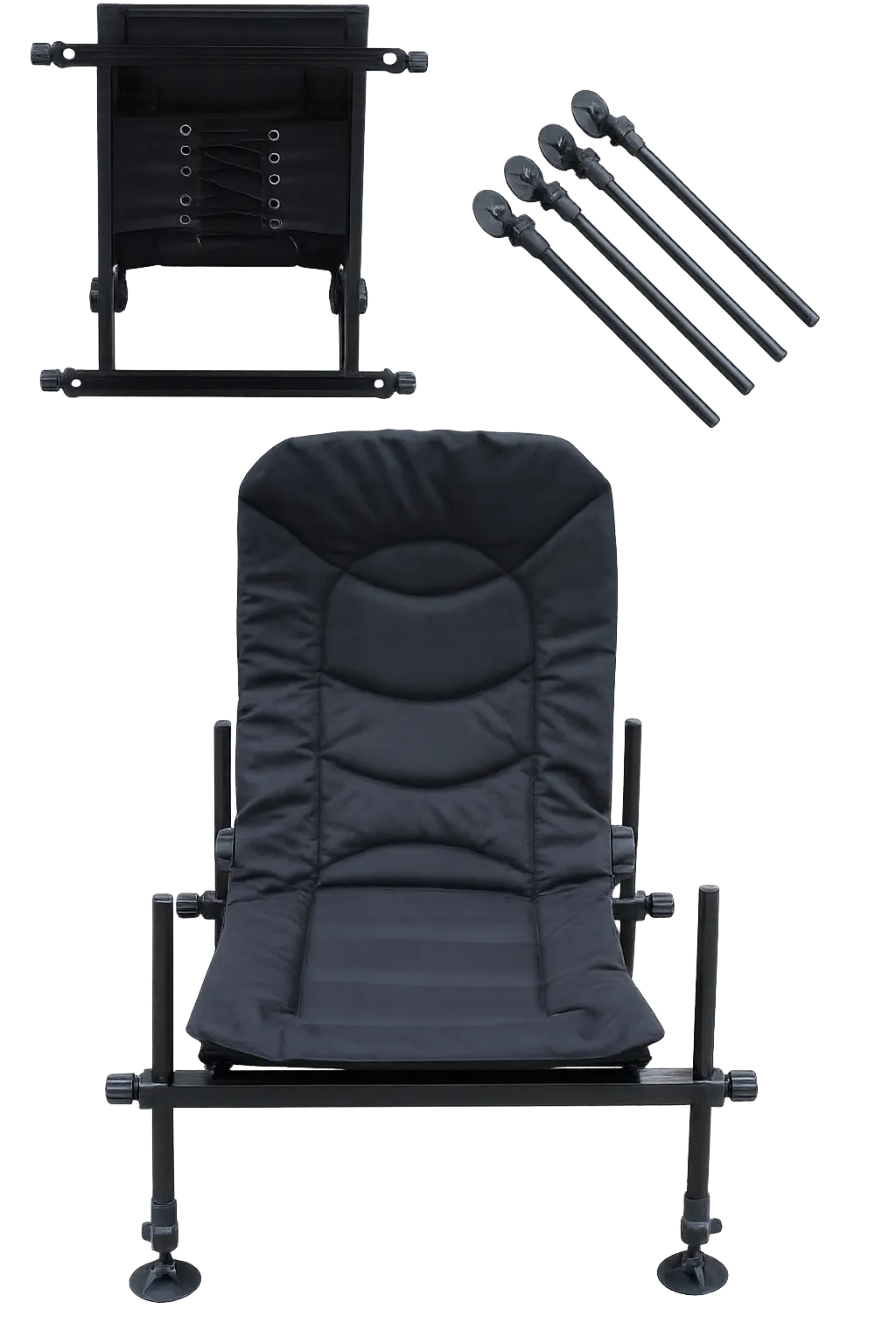
Do not accept "heavy duty" as a substitute for a number. Our FC-CR-03 carp chair uses 1.2mm wall on every structural member , ask your manufacturer for the same in writing.
Powder Coating: 40 Microns Is the Line Between One Season and Five
Powder coating thickness is the most overlooked spec in OEM chair procurement. A spec sheet will say "powder coated." That means nothing.
A coating below 40 microns fails within 12 months in coastal conditions , salt air plus UV plus daily temperature cycling eats through thin coating faster than you would believe.
I pulled a chair from a return batch in Felixstowe last year. The frame had 22 microns of coating. The chair was nine months old. It looked like it had spent a decade on a beach.
Bring a coating thickness gauge to your factory visit. They cost about £40 on Amazon. Test five random frames from the current production run. If the average is under 40 microns on the leg tubes, reject the batch.
This single test prevents the most common warranty failure in European carp fishing chairs , frame corrosion starting at the leg adjustment holes within the first season.
Factory Audit Checklist: 7-Point Pre-Production Walkthrough
Here is the checklist I use when auditing a carp fishing chair factory before placing a first order. Each item takes 3-5 minutes to verify. The whole walkthrough runs under 30 minutes.
Do it before you discuss pricing , the factory's reaction to each check tells you more than any price negotiation.
| Checkpoint | What to Look For | Red Flag |
|---|---|---|
| 1. Welding station | Both sides of every leg bracket welded. Consistent bead width (3-4mm). No spatter on finished joints. | Single-side welds, inconsistent bead width, slag not cleaned between passes. |
| 2. Foam cutting area | Density labeled on raw foam blocks. 3-second rebound on offcuts. Consistent thickness across the cut face (±1mm). | Unlabeled foam blocks, rebound >5 seconds, visible thickness variation on cut edges. |
| 3. Alloy storage rack | Grade stamps visible on every tube. Segregated by alloy type. No mixed storage. | Unmarked tubes, 6061 and 7005 stored together, rust on stored steel tubing. |
| 4. Coating line | Minimum 40 microns on all structural members. Consistent colour across a production batch. No orange peel texture. | Thin spots at tube ends and adjustment holes, colour variation within a batch, rough surface texture. |
| 5. Fabric inspection | 600D Oxford minimum with PU backing label visible. 3 stitches/cm on all load-bearing seams. No skipped stitches. | Unlabeled fabric rolls, stitch density below 2.5/cm, single-needle seams on seat panels. |
| 6. Assembly line | Torque-controlled tools on all bolted connections. Quality check station between welding and assembly. Finished chairs load-tested (130kg static, 24 hours). | Hand-tightened bolts, no inline QC station, no load-test rig visible on the production floor. |
| 7. Packaging area | Individual carton with foam corner protectors. Carton drop-tested from 1m. Moisture barrier bag for sea freight. | Chairs packed directly into master cartons without individual protection, no drop-test equipment. |
MOQ and Pricing Signals: What "Standard Pricing" Actually Means
A factory that quotes you a single price without asking about order volume does not understand their own cost structure. Real pricing has tier breaks.
A steel-frame carp chair at $18-24 FOB Ningbo at 300 units drops to $15-20 at 500 units and $13-17 at 2,000 units.
An aluminum chair at $28-42 at 300 units drops roughly 12-15% at the 500-unit break and another 8-10% at 2,000.
Custom powder coat colours add $1.50-2.50 per unit with a 50-100 unit minimum per colour. Custom embroidery on the seat back runs $0.60-1.20 per unit with a 200-unit minimum.
Custom hang-tag and retail packaging adds $0.80-1.50 per unit , and this one catches first-time buyers because the unit cost sounds small until you multiply by 500.
One pricing signal I always check: ask the factory for their 40HQ container loading count for the chair model you are ordering.
A factory that can answer immediately , "624 units in a 40HQ for this model" , has shipped this product before. A factory that pauses to calculate is guessing. Our FC-CR-05 compact chair loads 780 units per 40HQ.
That number alone saves a buyer roughly $1.20 per unit in freight compared to a chair that packs 550 per container.
Common Failure Points: Where Carp Chairs Break and How to Write Them Out of Your BOM
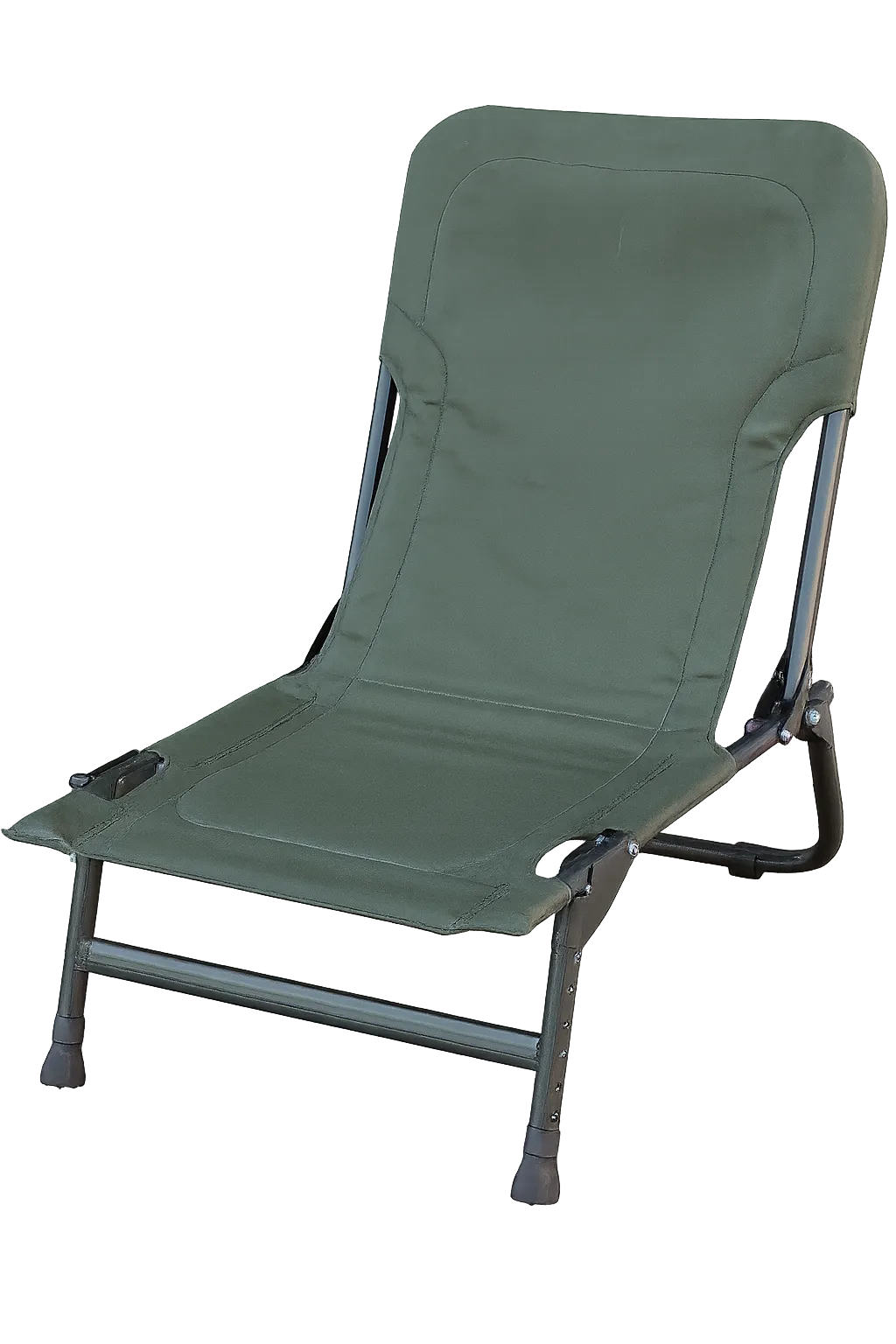
After 15 years of watching warranty returns come back through our inspection bay, I can tell you exactly where carp fishing chairs fail. Five failure modes account for roughly 85% of all returns. Here they are, ranked by frequency, with the specification line that prevents each one.
Leg bracket welds (35% of returns). This is the number one failure. A single-sided weld on the leg bracket holds for about six months of regular use, then cracks at the heat-affected zone.
Fix: specify "full-penetration double-sided fillet weld on all leg bracket joints" in your OEM agreement. Ask for destructive test photos , a sawed cross-section of a sample weld showing full penetration. No photos, no order.
Seat foam collapse (22% of returns). Already covered in the foam section above. One addition: the foam-to-fabric lamination matters as much as the density.
If the foam is simply stuffed into a fabric pocket without bonding, it shifts within 30 hours of use and creates an uneven sitting surface. Specify "full-surface flame-laminated foam-to-fabric bonding."
Adjustment mechanism seizure (18% of returns). The telescoping leg mechanism , the pin-and-hole or twist-lock system that sets leg height , seizes when sand, mud, and bank grit work into the mechanism. Stainless steel pins help.
What helps more: a wipe-clean design with no internal cavities that trap debris. Open-channel leg adjusters fail less often than enclosed twist-lock mechanisms. See our failure analysis guide for the complete breakdown of mechanism types and their failure rates.
Fabric seam splitting (7% of returns). A seat panel seam stitched at 2.5 stitches/cm with single-needle lockstitch will split at the corner within one season.
The fix: 3 stitches/cm minimum, double-needle on all load-bearing seams, with bonded polyester thread , not nylon. Nylon absorbs water, swells, and degrades under UV within 18 months. Bonded polyester thread adds roughly $0.08 per chair.
For detailed QC standards across all chair components, read our quality control specifications guide.
Mud foot loss (3% of returns). The plastic foot on the bottom of each adjustable leg falls off during transport across soft ground. It sounds trivial until you process 47 warranty claims for a $0.15 part.
Fix: specify a retaining ring groove machined into the leg tube end, with a snap-fit mud foot that cannot be pulled off without tools. Threaded mud feet also work but add assembly time.
Frequently Asked Questions
6061 aluminum costs roughly $3.20/kg at billet, welds without post-weld heat treatment, and provides 310 MPa tensile strength. 7005 costs about $4.80/kg with 350 MPa tensile but requires post-weld aging , a step many budget factories skip.
For standard carp chairs under 130kg rated load, 6061 is the correct, cost-efficient choice. 7005 adds weight savings but demands documented heat-treating capability from the factory.
Standard MOQ starts at 200-300 units per design for standard powder coat colours. Custom colours add 50-100 units to the minimum.
Factory pricing shifts at the 500-unit and 2,000-unit thresholds , expect roughly 12-15% price reduction at 500 units and another 8-10% at 2,000 units.
Lead time runs 45-60 days from order confirmation, with sample production taking 7-10 days before mass production begins.
Use the 3-second rebound test: press your thumb firmly into the seat foam for 3 seconds, then release. Foam at 28-32 kg/m³ rebounds within 3 seconds and recovers its full shape.
Foam below 22 kg/m³ stays compressed for 5+ seconds and shows a visible indent. This single test predicts 18 months of warranty performance. Bring a density reference sample from your own specification for side-by-side comparison against the factory's production foam.
Specify 600D Oxford polyester with PU backing as the minimum. For premium chairs, 840D or 1200D Oxford adds roughly £0.80-1.20 per unit at factory gate but doubles abrasion resistance.
The PU coating thickness matters more than the denier number , demand minimum 0.15mm PU backing, tested to 20,000+ Martindale cycles. UV resistance requires a UV stabilizer additive in the coating, which adds approximately 3-5% to fabric cost.
A chair built with 6061 aluminum frame, 1.2mm wall thickness on leg tubes, 600D Oxford with proper UV-stabilized PU coating, and 28-32 kg/m³ foam typically delivers 3-5 seasons of bank use before showing material fatigue.
Powder coating below 40 microns fails within 12 months in coastal conditions. The fastest killer is UV exposure during storage , specify UV-stabilized materials even for inland markets.
As of mid-2026, FOB Ningbo/Shanghai pricing ranges from $18-24 per unit for a basic steel-frame chair (600D Oxford, powder-coated, 3.7kg) to $28-42 for a 6061 aluminum chair with adjustable legs, mud feet, and premium foam.
Custom powder coat colours add $1.50-2.50 per unit. Packaging in individual cartons versus bulk pallet adds $0.80-1.20 per unit. All prices assume MOQ of 300-500 units.
Sources & Industry References
- Aluminum alloy property data: ASTM B209/B209M standard specifications for aluminum sheet and plate , tensile and yield strength values for 6061-T6 and 7005-T6 tempers
- Foam density specifications: ISO 3386-1 polyurethane foam compression testing standards , industry reference for furniture and seating foam density classification
- Powder coating durability: ISO 9227 salt spray testing standard , corrosion resistance benchmarks for outdoor furniture coatings
- AnglinGear internal warranty return data: 2023-2026 failure mode analysis across 12,000+ units shipped to European distributors
Ready to Audit a Carp Fishing Chair Factory?
We walk buyers through our production floor with this exact checklist. No appointments, no scripted tour , you see the welding station, the foam cutting area, and the coating line as they run.
Request a Factory Visit or Quote(Updated July 2026 to reflect current FOB pricing and alloy market rates. Factory audit checklist revised based on Q1-Q2 2026 production audits in Zhejiang province.)