The day shelter occupies a procurement blind spot. Buyers who specify bivvies with care often treat the day shelter as an afterthought, a smaller cheaper bivvy. That assumption leads to spec sheets that miss the product's actual job: fast setup, wind-ready geometry, and just enough weather protection for a 6-hour session. This guide is how we spec day shelters at the factory floor level.
The Day Shelter Blind Spot in B2B Procurement
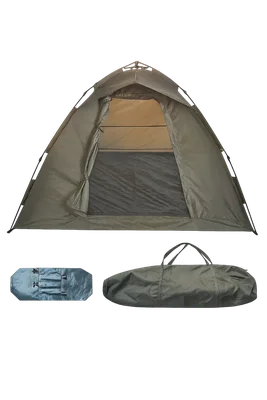
The day shelter sits between two well-understood categories. On one side, the compact brolly: light, fast, minimal coverage. On the other, the full carp bivvy: heavy, full enclosure, overnight-rated. The day shelter, often called an oval brolly, does neither job fully and both jobs partially. That makes it hard to spec, easy to get wrong.
At AnglinGear, we see the day shelter category growing across UK and EU markets. Anglers who fish 4 to 8 hour sessions want more than a brolly but do not need a full overnight bivvy. The day shelter fills this gap with three-sided coverage, an oval hub or twin-rib frame for extra headroom, and a packed weight under 5 kg. Get the spec right and it becomes a volume SKU. Get it wrong and it sits in the warehouse through two seasons before the clearance pricing starts.
This guide walks through the procurement decisions that separate a day shelter that sells from one that returns.
Day Shelter vs Bivvy vs Brolly: Where It Fits
Before writing a spec sheet, a buyer needs to know exactly where this product lands on the shelter spectrum. The table below puts the three categories side by side at OEM-level realities, not brochure claims.
| Feature | Brolly | Day Shelter (Oval Brolly) | Bivvy |
|---|---|---|---|
| Setup Time | 30-45 seconds | 30-60 seconds | 3-5 minutes |
| Headroom | Low, single spine | Medium, oval/rib design | High, full standing |
| Weather Protection | Front-only coverage | 3-side coverage with front | 360-degree full enclosure |
| Packed Weight | 2-3 kg | 3-5 kg | 5-9 kg |
| Packed Size | 120-140 cm | 130-160 cm | 110-130 cm (varies) |
| OEM Unit Cost | $15-30 | $25-55 | $45-120 |
| Typical Session | 1-3 hours | 4-8 hours | Overnight+ |
The day shelter is the middle child of the shelter lineup. It gives anglers three-sided coverage, extra headroom through an oval hub or twin-rib frame, and a footprint large enough for a chair plus side tray. It does this without the weight penalty and 5-minute setup of a full bivvy. For distributors, the category hits a price point ($25-55 OEM) that moves volume while carrying better margin than entry-level brollies.
Oval vs Square Hub: The Design Trade-off
Hub geometry determines everything downstream: weight, wind performance, floor space, and manufacturing cost. Two approaches dominate the OEM market.
Oval hub systems spread the canopy wider without adding poles. A standard 2-rib oval brolly opens to roughly 170-200 cm width with 130-150 cm depth. The curved profile sheds wind gusts rather than catching them. Frame weight lands around 1.5-2.3 kg in aluminium. Push-up hub mechanism means setup takes 30 seconds once the angler knows the motion.
Square hub designs use 4 short ribs to create a rectangular footprint. More floor space for the same pole count, simpler geometry to manufacture, lower per-unit frame cost. The trade-off: square profiles catch crosswinds. A square hub shelter needs an extra 400-600 grams of frame material or additional guying points to match the wind performance of an oval hub.
For UK market, oval hub dominates. Wind matters more than an extra 15 cm of floor width. For continental European markets with large stillwater lakes and less wind exposure, square hub designs find acceptance at the entry-level price tier.
Frame Materials: Steel vs Aluminum
Frame material is the single largest cost driver and the primary determinant of product lifespan. Pick wrong and your customers know within one season.
| Property | Steel (Q195/Q235) | Aluminum (6061/6063) |
|---|---|---|
| Frame Cost (OEM) | $3-7 per unit | $8-18 per unit |
| Frame Weight | 2.5-3.5 kg | 1.5-2.3 kg |
| Wall Thickness | 0.8-1.0 mm | 1.0-1.2 mm (specify min 1.0 mm) |
| Corrosion Resistance | Powder coat required. Pitting at joints within 12-18 months | Natural oxide layer. Anodising adds 5+ years to joint life |
| Service Life | 1-2 seasons | 3-5 seasons |
| Best Fit | Entry-level price point, dry-climate markets | Mid-range to premium, UK and coastal EU markets |
Our standard recommendation for B2B buyers: 6061 aluminium with 1.0 mm wall thickness, anodised finish. The material cost difference of $5-10 per unit translates to a product that lasts 3-5 seasons instead of 1-2. Your customers notice. Warranty claims on steel-frame shelters run 3-5 times higher than aluminium across the same sales volume.
Fabric Specs: Denier, Coating, Hydrostatic Head
Three numbers control fabric performance. If your RFQ does not specify all three, the factory picks the cheapest combination that meets your price target.
Fabric Denier (D)
- 210D polyester: Entry level. Adequate for light rain in occasional-use products. 1-2 season lifespan. OEM cost: $1.50-2.50 per m².
- 300D polyester: Mid-range. Good for regular weekend use. 2-3 seasons. OEM cost: $2.50-3.50 per m².
- 420D polyester: Commercial grade. Holds up to UV exposure and repeated packing cycles. 3-5 seasons. OEM cost: $3.50-5.00 per m².
- 600D polyester: Overkill for shelters. Adds weight with marginal durability gain over 420D in this application. OEM cost: $5.00-7.00 per m².
PU Coating Layers
- Single PU coat: 800-1,500 mm hydrostatic head. Rain protection for 30-60 minutes.
- Double PU coat: 2,000-3,000 mm hydrostatic head. Sustained rain for 2-3 hours.
- Triple PU coat: 3,000-5,000 mm hydrostatic head. Heavy downpour, all-day protection.
Market-Specific Guidance
For UK market, specify 3,000 mm minimum with double PU coating. UK rain is persistent, and a shelter that leaks after 45 minutes generates returns at a rate we have measured at 8-12% for sub-2,000 mm products versus under 2% for 3,000 mm and above. For Mediterranean markets, 2,000 mm is sufficient. Factor the $2-4 per unit coating upgrade against your return rate and the math is straightforward.
Taped seams: Specify fully taped seams on every panel joint. A shelter with 5,000 mm fabric but untaped seams will leak through stitch holes within the first hour of rain. Tape sealing adds $1.50-3.00 per unit. Skipping this line item is the most common cost-cutting mistake we see on first-time OEM orders. The returns follow within one season.
Procurement Spec Sheet: What to Specify
When you send an RFQ to a factory, every blank field is a factory assumption. Factories optimise for cost. You optimise for market fit. Here is the minimum spec sheet we recommend sending with your inquiry.
| Spec Item | What to Specify | Notes |
|---|---|---|
| Frame material | Alloy grade (6061 or 6063), wall thickness, anodised yes/no | 1.0 mm minimum on aluminium |
| Hub type | Oval push-up or square rib | Oval for UK/windy markets |
| Pole diameter | Main pole 16-19 mm, rib poles 8-11 mm | Thicker main pole = better wind stability |
| Fabric | Denier, PU coat count, hydrostatic head | 420D double-PU for mid-range and above |
| Seams | Taped or untaped | Specify "fully taped" explicitly |
| Packed size | Target max length (140-160 cm typical) | Affects container loading |
| Total weight | Target max (3.0-5.0 kg) | Aluminium frame essential for under 4 kg |
| Pegs | Material (steel vs aluminium), quantity (4-8), length (20+ cm) | Steel pegs, 20 cm minimum for soft ground |
| Carry bag | 210D or 420D, compression straps yes/no | Compression straps reduce packed diameter |
| Storm caps | Included or optional | Adds $0.50-1.00 per unit |
| Colour | Standard (green/camo) or custom (Pantone) | Custom colour adds MOQ |
| Rear vent | Peak-out window with mesh backing yes/no | Reduces condensation |
| Front panel | Removable or fixed | Removable adds versatility |
| Groundsheet | Included (PE 120 gsm) or clip-in optional | PE groundsheet adds $1.00-2.00 per unit |
Write the spec sheet like a contract because at the production stage, that is what it becomes. Every omitted field is a cost-down decision made without you.
MOQ and Container Loading Estimates
MOQ structure for OEM day shelters follows a predictable ladder. The numbers below reflect our production floor experience, not catalogue estimates.
| Order Type | MOQ | Additional Cost |
|---|---|---|
| Standard design, stock colour | 100-200 units | None |
| Custom colour (Pantone match) | 300-500 units | None (absorbed at quantity) |
| Custom frame geometry | 500+ units | $800-2,000 tooling fee |
| Custom fabric print (brand logo) | 300+ units | $200-500 screen fee |
Container Loading
A 40-foot HQ container holds roughly 700-900 day shelters, depending on packed dimensions. At 150 cm packed length with a 20 cm diameter bag:
- Per carton: roughly 155 × 22 × 22 cm
- Cartons per pallet: 12-16
- Pallets per 40HQ: 22-24
- Total units per 40HQ: 700-900
A 20-foot container holds roughly 300-400 units. Lead time runs 30-45 days from order confirmation for standard designs, add 15-20 days for custom colours or new tooling.
EU/UK Compliance: Three Things to Verify Before the PO
Compliance paperwork is easy to promise and easy to fake. These are the three areas where we advise clients to request actual documents, not verbal assurances.
1. REACH (EU Regulation 1907/2006)
Fabric coatings, dyes, and frame finishes must comply with REACH substance restrictions. The PU coating process uses solvents that are regulated under REACH. Request a REACH compliance certificate from the factory that names the specific product, not a generic factory-level declaration. A generic certificate covers the factory. A product-specific certificate covers your shipment.
2. UKCA and CE Marking
Products sold in Great Britain require UKCA marking. Products for EU markets still need CE. Most factories CE-mark by default because the EU is the larger market. Specify UKCA explicitly if your primary market is UK. The cost difference is in the paperwork, not the product. The risk difference is a held container at Felixstowe.
3. GPSR (General Product Safety Regulation)
Effective December 2024, the EU GPSR requires an authorised representative within the EU for non-EU manufacturers. If you import into the EU without this, customs can hold your container. We maintain EU authorised representative coverage for our OEM clients. Ask any supplier you evaluate how they handle GPSR compliance. A blank look is a red flag.
For frame structural testing, EN 581 (outdoor furniture standard) is the closest applicable standard for fishing shelters. Request load test reports showing the frame can withstand 25-30 kg hanging weight distributed across the hub without permanent deformation.
B2B Buying Checklist
Before confirming a purchase order, run through this checklist. Every "no" is a conversation to have with your supplier before money moves.
| Checkpoint | What to Ask | Red Flag |
|---|---|---|
| Frame alloy | Confirm 6061 or 6063 grade with wall thickness spec | "Steel" without alloy grade; wall thickness under 0.8 mm |
| Fabric | Denier, PU coat count, hydrostatic head test report | "Waterproof" without numbers |
| Seams | Factory tape-seals all seams? What tape width? | "Fabric is waterproof" as answer to seam question |
| Hub mechanism | Push-up lock type, spring-loaded or friction? | Plastic hub components |
| Pegs | Material and length? 20+ cm for soft ground | 15 cm pegs, stamped steel |
| Compliance | REACH certificate, CE/UKCA DoC on file | "We export to Europe" with no documents |
| Sample policy | Pre-production sample included? Cost? | No pre-production sample policy |
| Packed size | Verified with actual packed sample photo | "About 150 cm" without measurement photo |
| After-sales | Spare pole sections, hub, pegs available for reorder? | No spare parts program |
Market Drivers: Why Day Shelter Demand Is Growing
Three trends are pushing the day shelter category forward in UK and EU markets. Understanding them helps procurement managers allocate volume correctly.
- Session-length shift. Day-ticket carp waters with 6-8 hour sessions are growing faster than 24-hour syndicate waters. Anglers fishing 6 hours want shelter without the setup overhead of a bivvy. The day shelter is the category that matches this session length.
- Weight consciousness. Barrow-loaded anglers care about every kilogram. A 3.5 kg day shelter versus a 7 kg bivvy is a real choice on waters with a 10-minute walk from parking. We see this in order patterns: distributors who stock both categories report day shelter volume growing 15-20% year on year while bivvy volume stays flat.
- Price-point expansion. At $25-55 OEM, the day shelter opens a price band below the entry bivvy ($45+) but above the basic brolly ($15-30). For retailers, this means a new shelf position. For distributors, a new SKU that does not cannibalise existing bivvy sales because the use case is different.
Frequently Asked Questions
They describe the same product category. "Oval brolly" refers to the hub shape. "Day shelter" refers to the use case: a shelter for day sessions that provides more protection than a standard brolly without the full enclosure of a bivvy. In the UK market, the terms are used interchangeably. "Day shelter" is increasingly the trade term for models with removable front panels and rear vents, features that move the product closer to bivvy functionality without the weight.
3,000 mm minimum with double PU coating and taped seams. UK carp anglers fish in sustained rain. A shelter rated at 1,500 mm starts leaking within 30-45 minutes of steady rain. The coating upgrade from single to double PU adds roughly $2-4 per unit at OEM quantities. The return cost of a leaking shelter, including shipping and customer service time, runs $15-25 per incident. The math favours the coating upgrade at any volume above 50 units.
Oval hub systems deflect wind better because the curved profile does not present a flat face to gusts. In our testing, an oval hub shelter with 6 pegs properly tensioned holds steady in 25-30 km/h winds. A flat-rib brolly of similar weight begins to lift at 15-20 km/h. For UK and coastal European markets where wind is a daily factor, oval hub is the safer OEM specification. The frame geometry is the difference, not the fabric weight.
300-500 units for custom colour and logo printing. Standard designs in stock green or camo start at 100-200 units. Tooling cost for a new hub design runs $800-2,000 depending on complexity. Factor tooling amortisation into your landed cost. At 500 units, a $1,500 tooling fee adds $3 per unit, manageable for a mid-range product. At 200 units, it adds $7.50, which changes the price-point math.
Approximately 700-900 units in a 40HQ, depending on packed dimensions. A typical day shelter with 150 cm packed length and 20 cm packed diameter fills a carton of roughly 155 × 22 × 22 cm. Stack 12-16 cartons per pallet, 22-24 pallets per container. Your supplier should provide a load plan before shipment. A 10 cm reduction in packed diameter through compression straps on the carry bag adds roughly 80-120 units to a 40HQ load. That is real freight cost per unit you are leaving on the table if you skip the spec.
Spec the Product Your Market Actually Needs
Day shelter procurement rewards specificity. The product category is growing, the price band is attractive, and the use case is clear. The risk is that a generic spec sheet produces a generic product that neither competes with cheap brollies on price nor with bivvies on features.
A well-specced day shelter hits the middle ground: 420D double-PU fabric, 6061 aluminium oval hub frame, taped seams, 3,000 mm hydrostatic head, packed weight under 4 kg. At $35-45 OEM, that spec delivers a product anglers will buy at full retail and not return. A steel-frame 210D single-PU version at $20 OEM looks like margin on the spreadsheet and becomes a liability when the returns data comes in.
We have been manufacturing shelters in Weihai for over a decade. The spec decisions in this guide come from production floor experience, not marketing briefs. If you are preparing an RFQ for day shelters, we can provide a structured specification template with every field pre-set for factory quoting. It saves the back-and-forth and ensures both sides are working from the same numbers.
Read our winter vs 3-season bivvy procurement guide for the overnight shelter category, or see our carp barrow OEM procurement guide for transport gear specs. For a full overview of our shelter manufacturing capabilities, visit our products page.
Ready to Spec Your Day Shelter?
Request our shelter specification template, a one-page RFQ form with every field pre-structured for factory quoting. No back-and-forth, no missed specs.
Request Specification Template(This guide is updated as material costs, compliance requirements, and market data change. Last reviewed: July 2026.)