Barcelona, June 10th. Hall 2 at Fira Montjuïc. The doors opened at 9:00 AM this morning and the first wave of distributors, brand managers, and factory reps walked onto the show floor.
I know the smell of a trade show at opening hour , fresh carpet, coffee from the concession stand, and the faint metallic scent of new samples unwrapped for the first time.
EFTTEX 2026 is live. And if you're a European tackle brand sourcing from Asia, this is the show that sets the tone for your Q3 and Q4 buying decisions.
Pure Fishing is back. That's bigger than it sounds.
The biggest story coming into this year's show isn't a new product , it's a return. Pure Fishing, the world's largest tackle manufacturer, is back at EFTTEX after pulling out during COVID.
Their brands , PENN, Savage Gear, Berkley, Abu Garcia, Pro-Logic, DAM , are on the floor with 2027 ranges.
Jan Mertens, Pure Fishing's Commercial Director, told Angling International that he expects 25 to 30 of their top accounts at the show. When the anchor tenant returns to the mall, foot traffic follows.
For OEM factories, this changes the calculus. When Pure Fishing exhibits, the supply chain managers who place 20,000-unit quarterly orders are walking the aisles. They're comparing frame welds. They're pulling on zippers. They're asking about wall thickness without being prompted.
I've stood in enough booths to know: the buyers who come to a show where Pure Fishing exhibits are not the same buyers who come to a small regional event. They write bigger POs and ask harder questions.
Over 400 exhibitors. But the real action is in the conversations.
The official numbers: over 25,000 square meters of exhibition space, more than 400 exhibitors, with attendance projected to match previous years' turnout of around 28,000 visitors across three days. But anyone who's done business at EFTTEX knows the numbers don't tell the story.
Three types of conversations happen at this show:
The five-minute booth scan. A distributor walks up, picks up a chair, presses on the seat fabric, checks the leg welds, nods, takes a card. This buyer knows what a 1.2mm wall thickness feels like versus 1.5mm. They don't need a pitch. They need confirmation.
The forty-minute spec deep-dive. A brand manager sits down with a factory rep. They go through fabric swatches, foam density options, zipper brands, stitching patterns. By the end, they've sketched a modified bedchair on the back of a brochure. This is where OEM deals start.
The accidental meeting. Two people who've been emailing for six months finally meet face to face. They've already agreed on pricing. The handshake at EFTTEX is the last piece.
If you're sourcing from China and you're not at this show, your competitors are having all three of these conversations without you.
What European distributors are actually asking about this year
The questions I'm hearing from the floor tell you more than any press release:
"Can you do a 7005 aluminium frame instead of 6061?" More brands want the strength-to-weight advantage of 7005-series tubing, even at the cost premium. With 7005 tubing, a 4.3kg bedchair drops to roughly 3.9kg , about a 10% weight saving.
On a container of 200 units, that's 80kg less freight weight. The alloy costs more and the welding needs more skill, but for brands positioning at the premium end, the spec sells.
"What's your MOQ on a custom powder coat colour?" OEM customisation in 2026 isn't just about a logo embroidery anymore. Buyers want proprietary frame colours , matte olive, gunmetal grey, the exact Pantone that matches their brand deck.
In our experience, most factories need 300-500 units per colour to justify the powder coat line changeover.
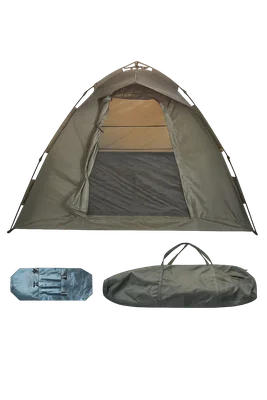
"Can your bivvy fabric hit 10,000mm hydrostatic head?" Ten years ago, 5,000mm was premium. Now 10,000mm is the table stakes for a 2-man bivvy aimed at the UK winter market.
Nash Titan Hide XL, Trakker SLX 100, Fox Frontier , the major brands all ship at 10,000mm or higher. The fabric cost difference at factory gate, in our experience: roughly £1.80 per meter.
On a bivvy using 15 meters of fabric, that's £27 per unit , significant at scale.
"What's your lead time from deposit to FOB?" The answer everyone wants is 30 days. In our experience, the honest answer for a custom OEM order with new tooling is closer to 60-75 days.
Factories that promise 30 days on a custom run are either lying or cutting corners. Either way, that conversation ends badly six months later when the warranty claims start.
Three product categories heating up at EFTTEX 2026
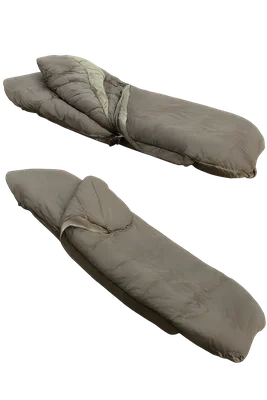
Sleep systems. The days of selling a sleeping bag as an afterthought are gone. European brands are now treating the sleep system , bag, mattress, bedchair , as a coordinated product line.
A 5-season sleeping bag with a twin-shell micro-fleece construction is no longer a premium add-on. It's what buyers expect as standard.
Fishing chairs. OEM fishing chairs are still the backbone of any carp tackle range. But the spec conversation has shifted.
Buyers aren't asking "do you have chairs?" , they're asking about 6061 vs 7005 aluminium, 25mm vs 30mm leg diameters, 600D Oxford with PU coating vs 420D ripstop.
The weight-to-strength ratio determines whether a chair lands in the "premium" or "entry-level" catalogue slot.
Bivvies. A 2-man fishing bivvy that sells for £299 retail needs to deliver 10,000mm waterproof ratings, taped seams, reinforced pegging points, and a breathable inner skin.
In our experience, the factories that can hit all four checkboxes at a £60-80 FOB are the ones getting the orders. The ones still quoting 5,000mm hydrostatic head are getting passed over.
The BNP Awards: a signal for where the market is going
The Best New Product competition at EFTTEX added three new lure categories this year , Freshwater Hard, Soft, and Metal. Livingston Lures, the Texas-based EBS technology company, has won awards at the last two European shows and is back with five new models designed and tested in the Netherlands.
Erick Arnoldson, VP Sales at Livingston, put it plainly: "The awards validate the direction we're taking." For European distributors, the BNP shortlist is essentially a cheat sheet for what consumers will want in 12 months.
If a product wins in Barcelona, you'll see knockoffs at the CGC Weihai show four months later. That's not cynicism , that's how the supply chain works.
What this means for your Q4 sourcing
If you're placing OEM orders for Q4 2026 delivery, the decisions made at EFTTEX this week will affect your options:
Lead times will stretch. Every factory rep at the show is collecting business cards. In our experience, the good factories will be fully booked within three weeks. Place your deposit now or wait until January.
Specs set the price floor. The brands showing 10,000mm bivvies and 7005-aluminium chairs at EFTTEX are setting the new baseline. If your manufacturer is still quoting 5,000mm fabric and 6061 frames, your retail price point just became "budget" , whether you intended it or not.
Relationships close deals. The distributors who flew to Barcelona, walked the floor, sat down with manufacturers, and inspected samples in person will get priority allocation when production slots fill up. Email-only buyers go to the back of the queue.
That's not fair , but it's how every factory I've ever worked with operates.
For a deeper look at how to structure your sourcing before approaching factories, our procurement guide covers MOQs, quality checkpoints, and shipping terms.
The show that matters
EFTTEX 2026 runs through June 12th at Fira Barcelona Montjuïc. If you're not here, the conversations are still happening , just without you in the room.
And if you're sourcing carp fishing sleep systems, chairs, or bivvies for the 2027 season, the spec sheet you write in the next two weeks will determine your margins for the next twelve months.