Table of Contents
Every year, a procurement manager sits down with a spreadsheet and a stack of catalogues and tries to answer one question: which carp fishing chair deserves shelf space in my shop?
It sounds straightforward. It isn't.
The difference between a chair that sells through cleanly at 45% margin and one that generates returns, warranty emails, and disappointed customers isn't visible in a catalogue thumbnail. It lives in the tube wall thickness, the foam density rating, the leg-lock mechanism type, and the folded dimensions that determine whether the chair fits in a customer's car boot — and whether it fits efficiently in your container.
This guide gives you a structured evaluation framework. Not a product catalogue. A lens. Walk each chair you're considering through these five specs, three price tiers, and seven manufacturer questions, and you'll know which one belongs in your order — and which one belongs in someone else's.
The Five Specifications Every Retail Buyer Should Check First
Most retail buyers start with the price. Experienced buyers start with five specs that predict return rates, customer satisfaction, and repeat business. Here they are, in order of importance.
1. Frame Material: What the Metal Tells You
The frame is the chair. Everything else — fabric, armrests, carry bag — can be swapped or repaired. The frame can't.
Two materials dominate the market: 6061 aluminium and powder-coated steel. The decision between them shapes your return rate, your shipping cost, and your customer demographic.
Aluminium chairs weigh 2.8–4.0 kg and resist corrosion without a coating. They appeal to mobile anglers who walk to their swim — the customer who spends £50–80 on a chair and expects it to last five years. Steel chairs weigh 5.0–7.0 kg and rely on an intact powder coat for rust protection. They appeal to static carp anglers and budget-conscious buyers — the customer who wants a solid seat at £30–45 and isn't carrying it half a mile.
One spec matters more than the material choice itself: tube wall thickness. Specify 1.2mm minimum on aluminium frames and 1.0mm minimum on steel. Below those thresholds, the leg junction welds become stress concentrators. A 0.9mm aluminium tube will hold 130 kg on day one. By season two, with 10,000 load cycles of an angler shifting position, the rear leg collar starts to ovalize and the wobble begins.
Ask your supply partner for the alloy grade, not just "aluminium." 6061-T6 is the standard. 7005-series adds strength but increases cost. If they can't tell you the grade, they're buying unbranded extrusion and the batch-to-batch consistency will drift.
2. Weight Capacity: Why the Rating Number Isn't Enough
Every catalogue lists a weight rating: 120 kg, 130 kg, 150 kg. These numbers are marketing as often as they are engineering.
What you need to know: static load rating vs. dynamic load reality. A chair rated for 130 kg static load was tested with weight placed gently in the center of the seat and held still. Your customer doesn't sit still. They lean forward to strike. They twist to reach the bait bucket. They shift position forty times in a four-hour session. That's dynamic loading, and it multiplies the effective stress on every joint.
Practical rule: the chair's stated rating should carry a 1.5× safety factor for retail customers. If your customer base averages 90–100 kg (typical for Northern European markets), you want a chair rated at 150 kg static minimum. The extra headroom converts directly into fewer frame warranty claims.
Also check where the load rating comes from. A legitimate supply partner will reference a test standard — EN 581 for outdoor furniture, or an internal test protocol with specific cycle counts. A partner who says "it's strong, trust us" is signalling that they've never tested it.
3. Leg System: The Part That Fails First
If warranty returns on fishing chairs were a pie chart, leg mechanism failures would be the biggest slice. The legs take every bump, every awkward fold, every muddy insertion.
Three leg-lock designs dominate the market:
- Telescopic twist-lock: The inner leg tube rotates to expand a plastic collar against the outer tube. Most common. Reliable when the collar material is glass-filled nylon. Fails quickly when the collar is unfilled polypropylene — it strips within months.
- Spring-pin with multiple height holes: A spring-loaded pin clicks into preset holes. Mechanically simple and hard to break, but offers fewer height positions. Popular on budget steel chairs.
- Lever clamp: A cam lever compresses the outer tube onto the inner leg. Fast and secure, but requires precise machining tolerances. Works brilliantly on a £70+ chair; produces endless wobble on a £25 chair.
For retail, the twist-lock with a glass-filled nylon collar hits the sweet spot of cost, reliability, and user experience. Avoid chairs where the leg-lock collar is visibly thin plastic — if you can flex it with your thumb, your customer's boot will finish the job within twelve months.
Also check the foot design. Large-diameter swivel feet with a deep tread pattern handle mud and gravel. Small plastic dome feet handle nothing. A chair with good legs and bad feet is like a car with good brakes and bald tyres — the weak point determines the failure.
4. Seat Padding: Comfort That Survives the Showroom
Retail buyers often evaluate padding by sitting on the floor sample. That's a five-second test. It tells you nothing about month eight.
What matters is foam density, measured in kg/m³. Budget chairs use foam at 25–35 kg/m³ — it feels plush on day one and collapses to a pancake by August. Mid-range and premium chairs use 50–70 kg/m³ foam that holds its shape through three seasons of weekly use.
The minimum to specify: 50 kg/m³ polyurethane foam with a PE foam backing layer beneath the seat fabric. The backing layer prevents the foam from bottoming out against the frame crossbar — a sensation your customer will describe as "the bar's digging into my leg" on review sites.
Fabric matters here too, and it interacts with padding. A 600D Oxford polyester seat cover backed with PE foam will hold its shape. A 420D cover without backing will stretch under sustained load, creating a hammock effect that concentrates pressure on the frame edges and accelerates fabric wear.
5. Pack Size: What Fits in Your Customer's Car — and Your Container
This spec gets overlooked more than any other, and it costs money at both ends of the supply chain.
For your customer: measure the folded dimensions of any chair you're considering. A folded length above 85 cm won't fit across the boot of a typical hatchback. Your customer discovers this on the first fishing trip, can't close their boot, and returns the chair — not because it's defective, but because it's impractical. A retail buyer in the Netherlands once told us he'd rejected three perfectly good chairs solely because their folded length exceeded 82 cm, the width of his average customer's car boot.
For your logistics: folded dimensions determine carton quantity per pallet and per container. A chair that folds to 55 × 15 × 50 cm packs differently from one that folds to 70 × 20 × 60 cm. The difference can be 600 units in a 40HQ versus 450. At $3–5 per unit in sea freight, that's $450–750 in shipping cost variance on a single container. Multiply by four containers a year and you've got real money.
Ask for a physical carton sample. Not a spec sheet. An actual box. Measure it, weigh it, and count how many fit in a cubic meter.
Price Tier Comparison: Budget, Mid-Range, and Premium — What You Actually Get
Fishing chairs for retail sort into three price bands. Each band makes different tradeoffs. The skill isn't picking the cheapest or the most expensive — it's matching the tier to your customer demographic.
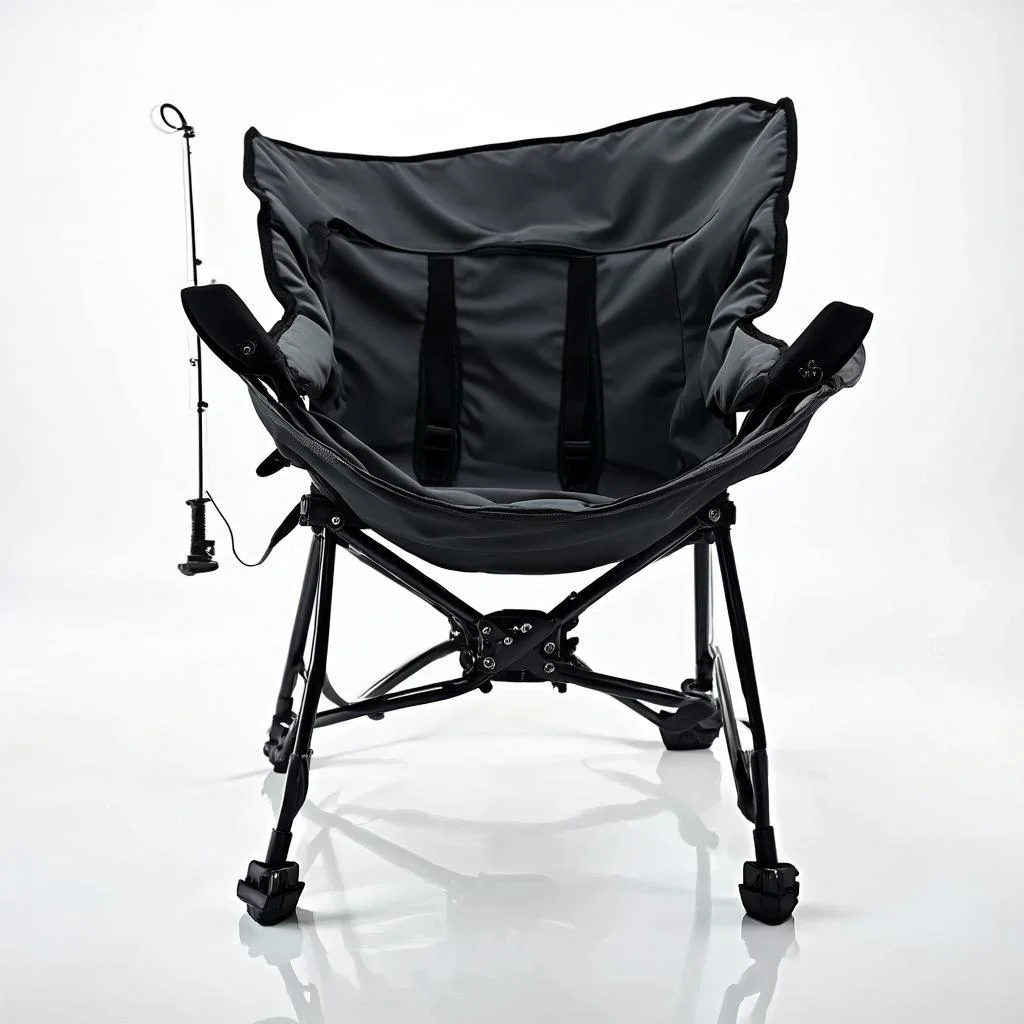
| Specification | Budget (£25–40 Retail) | Mid-Range (£40–65 Retail) | Premium (£65–90+ Retail) |
|---|---|---|---|
| FOB unit cost | $8–14 | $15–22 | $23–35+ |
| Frame material | Steel, basic powder coat | 6061 aluminium or upgraded steel | 6061-T6 aluminium, reinforced joints |
| Tube wall thickness | 0.8–1.0mm | 1.0–1.2mm | 1.2–1.5mm |
| Fabric | 420D polyester | 600D Oxford + PE backing | 900D Oxford or ripstop, memory foam |
| Leg system | Spring-pin or basic twist-lock | Telescopic twist-lock, nylon collars | Lever clamp or proprietary twist-lock |
| Foam density | 25–35 kg/m³ | 45–60 kg/m³ | 60–80 kg/m³, dual-layer |
| Weight capacity | 100–120 kg | 130–150 kg | 150–180 kg |
| Expected return rate | 8–12% | 2–5% | <2% |
| Best fit | Promotional lines, starter kits, rental fleets | Core retail range, tackle shop staple | Brand flagship, premium shelf position |
| Typical MOQ per colour | 200 units | 200–300 units | 300–500 units |
The mid-range band is where most retail buyers find their best margin-to-returns ratio. A chair at $18 FOB that retails at £49.99 with a 3% return rate outperforms a chair at $10 FOB retailing at £34.99 with a 10% return rate — every time. The math: on 200 units, the budget chair generates 20 returns at roughly £30 each in total handling cost (£600). The mid-range chair generates 6 returns at £180. The £420 difference more than covers the higher unit cost.
The premium tier makes sense when your retail brand competes on expertise, not price. A chair at £74.99 with a 1.5% return rate and a five-year expected lifespan creates a customer who comes back for a bedchair, a bivvy, and a sleeping bag — all from your shop, because the chair earned their trust.
Three Mistakes That Cost Retail Buyers Their Margin
Over years of working with distributors across Europe, three buying mistakes repeat with such regularity that we can predict them by the second email in an inquiry thread. Here they are — and how to avoid them.
Mistake 1: Buying by Catalogue Photo Alone
The catalogue photo shows the sample chair — the one built by the senior welder on a quiet morning with carefully selected fabric from the top of the roll. The production chair arrives three months later, built by the night shift during peak season, using fabric from a different dye lot.
Always request three random production samples before committing to a container order. Pulled from current inventory, not from the sample room. Check the tube wall thickness with a caliper across all three units. If the spread exceeds 0.3mm, the extrusion source is inconsistent — and your batch will be too.
Photograph the welds. Compare the fabric colour under daylight. Sit in each of the three samples and shift your weight thirty times. If the legs make different sounds or one collar feels looser than the others, the consistency isn't there.
Mistake 2: Ignoring Pack-Down Dimensions Until the Container Arrives
We've seen a distributor order 400 chairs, only to discover the folded length was 92 cm — too long for the average car boot in his market. He sold through the batch eventually, but at a 15% discount and with a return rate double his projection. The chair was fine. The dimension was wrong for his customer.
Before you order, measure the folded chair yourself. Take a tape measure to the sample. Ask: does this fit in a VW Golf boot? A Ford Focus? If your customers drive compact cars, 80 cm folded length is your ceiling. If they drive SUVs and vans, you've got more room — but you still need to know the number.
Mistake 3: Skipping the Spare Parts Question
Every chair will eventually need a replacement leg section, a new armrest, or a fresh carry bag. If your supply partner can't ship spare parts within 14 days of a request, every minor defect becomes a full-unit return or refund. A £5 replacement leg collar shipped in an envelope solves the problem. A £45 refund and a disappointed customer doesn't.
Before signing a purchase order, ask: "Can you supply individual spare parts — leg sections, armrests, locking collars — within 14 days to our warehouse?" If the answer is "we'll check" or "maybe for larger orders," treat it as a no. A reliable manufacturing partner stocks spares as standard operating procedure, not as a favour.
Also confirm the spare parts will remain available for a minimum of two years after the initial order. A chair model that becomes unrepairable six months after delivery leaves you holding inventory that can't be serviced — and customers who can't be helped.
Seven Questions to Ask Your Supply Partner Before Placing an Order
The best procurement decisions happen before money changes hands. These seven questions separate supply partners who understand retail from manufacturers who only understand production.
- "What alloy grade and tube wall thickness do you use, and can you provide a mill certificate?" — A partner who can produce the certificate isn't guessing about their aluminium. One who can't is buying whatever the extrusion mill had in stock that week.
- "What test standard do you reference for your weight capacity rating, and how many cycles was the frame tested to?" — Silence or "we test to international standards" without a specific EN number is a red flag.
- "What material is the leg-lock collar made from, and can I see a cross-section?" — Glass-filled nylon is the answer you want. Unfilled polypropylene or "high-quality plastic" without a material spec is the answer that predicts returns.
- "What foam density do you use in the seat and backrest padding?" — Below 50 kg/m³, expect the foam to collapse within one season of regular use. Get the number in writing.
- "What are the exact folded dimensions of the chair in its carry bag, and what is the carton quantity per 40HQ container?" — A supply partner who can answer both questions immediately has shipped retail orders before. One who needs three days to calculate carton quantities hasn't.
- "Can you supply spare parts within 14 days, and will you commit to two years of parts availability from the ship date?" — Get this in the contract. Verbal promises about spare parts have the shelf life of milk.
- "Can I visit the production line — or have a third-party inspector visit — and pull three random units from current inventory for independent testing?" — A partner who says yes to random sampling has confidence in their consistency. A partner who insists on sending hand-picked "samples" from the sample room is telling you everything you need to know.
These questions aren't aggressive. They're professional. Any manufacturing partner who has supplied European retail channels before will have the answers ready. The ones who don't were hoping you wouldn't ask.
Choosing a carp fishing chair for retail is a series of small decisions that compound. The frame material shapes your return rate. The leg-lock collar material shapes your warranty inbox. The folded dimensions shape whether the customer keeps the chair or drives it back to your shop. None of these decisions is complicated in isolation, but each one rewards the buyer who asks the question before the invoice, not after the delivery.
Pick your price tier honestly — match it to your customer, not your ambition. Check the five specs with a tape measure and a caliper, not a catalogue. Ask the seven questions. The chair that passes all of them is the one that earns shelf space — and earns it again next season.
Sources & Industry References
- Carpology Magazine — Leading European publication for carp fishing gear reviews and industry news
- EN 581 — European standard for outdoor furniture safety, strength, and durability testing
- Sedex — Ethical supply chain data exchange and manufacturer audit standards
Need Help Evaluating a Chair Spec?
Send us the spec sheet you're considering. We'll review it against these five criteria and share our assessment within 48 hours — no commitment, no pitch.
Send a Spec for Review(Last updated: July 21, 2026. Specifications and pricing reflect current market conditions as of this date.)