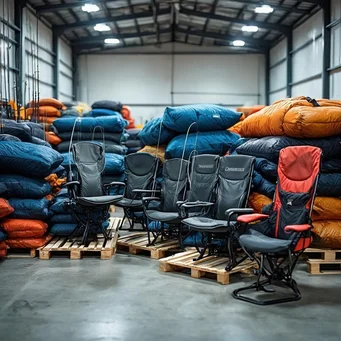
Author's Note: Every January, we watch the same panic unfold. European distributors who waited until after Christmas to place spring orders, suddenly realising their containers won't dock until April.
This article is the timeline we wish every buyer had taped to their wall.
What Actually Happens When You Order Too Late
Last January,a German distributor called us. He needed 400 fishing chairs and 200 bedchairs by mid-March for the spring carp season. His usual manufacturer had over-promised. We checked our production schedule.
The welding line was booked until February 20th. Shipping to Hamburg takes 35 days. He'd have stock in April. The season would already be underway.
He bought air freight for 200 chairs. The premium ate 60% of his margin on those units. The other 200 arrived by sea in late April.
By then, his competitors had already sold through their spring inventory. This story repeats every year, across at least a dozen distributors we supply. The pattern is always the same.
Here is what most distributors don't see: the factory order book tells you exactly who will have stock and who won't,six months before the season opens. The chart below is the real timeline, not the one in manufacturer brochures.
In This Guide
- How Long Does It Really Take from Order to Warehouse?
- What Seasonal Demand Curves Should Distributors Plan Around?
- How Much Buffer Stock Do You Need Per Product Category?
- Why Chinese New Year Destroys Inventory Plans
- What Mistakes Do Distributors Make Year After Year?
- A 12-Month Inventory Planning Calendar
How Long Does It Really Take from Order to Warehouse?
The number manufacturers quote is 45-60 days. That's production-only and assumes the factory is waiting for your order with open capacity.
Real total lead time, measured from the day you email the PO to the day pallets hit your warehouse, breaks down like this:
Sample confirmation: 7-10 days. If you're ordering a repeat SKU with no changes, skip this. If you're tweaking colours or fabrics, budget 10 days. Production: 30-45 days. This is what manufacturers quote.
It assumes all materials are in stock at the factory. Quality inspection: 3-5 days. Never skip this. Container loading and port processing: 5-7 days.
Ocean freight: 30-38 days port-to-port from Ningbo or Shanghai to Rotterdam, Hamburg, or Felixstowe. According to Maersk's 2025 shipping guide, plan for transit times of 30-45 days on the China-Europe route.
Door-to-door, with customs clearance and inland trucking, add another 7-10 days.
Total: 82-115 days. Call it three to four months.
Any manufacturer who tells you 60 days door-to-door is quoting production only, and you'll find out the hard way when your container is still at sea and your retail shelves are empty.
During peak shipping season (August through October, ahead of Christmas retail), port congestion at European hubs adds 5-10 days.
The Portcast Q4 2025 Transit Time Report found actual transit on the Asia-North/West Europe lane exceeded planned schedules by roughly 6 days on average, driven largely by Cape of Good Hope routing that has not normalised since the Red Sea disruption.
Real Door-to-Door Timeline by Destination
| Destination Port | Production | Ocean Freight | Customs + Inland | Total Door-to-Door |
|---|---|---|---|---|
| Rotterdam (NL) | 30-45 days | 30-35 days | 7-10 days | 67-90 days |
| Hamburg (DE) | 30-45 days | 32-38 days | 7-10 days | 69-93 days |
| Felixstowe (UK) | 30-45 days | 35-40 days | 10-14 days | 75-99 days |
| Le Havre (FR) | 30-45 days | 30-34 days | 7-10 days | 67-89 days |
What Seasonal Demand Curves Should Distributors Plan Around?
From our order book across 40+ European distributor accounts, the seasonal pattern is consistent. It is not one peak. It is three distinct waves, each demanding different product mixes.
Wave 1: Spring Carp Season (March-May). This is the biggest spike. UK and Northern European carp anglers come out of winter. Water temperatures hit 10°C and the banks fill up.
Products that peak in spring: fishing chairs, bedchairs, bivvies, carp mats, weigh slings, trolleys. Distributor ordering for this wave should be confirmed by early November the previous year.
Orders placed after January will miss the March retail window.
Wave 2: Summer Peak (June-August). Sustained demand across all categories. This is when European school holidays drive week-long fishing trips. Sleeping bags dip (too warm), but bivvy sales hold. Chairs and bedchairs stay strong.
This wave is easier to stock for because it follows spring inventory.
But distributors who sold out in spring need a May restock order , and that means February production, which conflicts with Chinese New Year.
Wave 3: Autumn Preparation (September-October). The second-biggest spike for specific categories. As temperatures drop, sleeping bags and 5-season sleep systems surge. Bivvy sales pick up again as anglers prepare for winter sessions.
Carp cradles and retention slings stay steady. Order for autumn stock by late May. A distributor who orders sleeping bags in August will receive them in November , after autumn carp fishing has peaked.
Seasonal Demand by Product Category
| Product Category | Peak Season | Order Deadline | Off-Season Risk |
|---|---|---|---|
| Fishing Chairs (Alu/Steel) | Mar-Jun | Early Nov | Low , sells year-round |
| Bedchairs | Mar-Jun, Sep-Oct | Early Nov / Late May | Medium , two peaks |
| Bivvies (1-man, 2-man) | Mar-May, Sep-Nov | Early Nov / Late May | Medium , year-round shelter |
| Sleeping Bags (5-season) | Sep-Nov | Late May | High , hot-season dead stock |
| Carp Mats / Cradles | Mar-Aug | Early Nov | Low , steady demand |
| Weigh Slings / Bars | Mar-Aug | Early Nov | Low , small, always needed |
| Trolleys / Barrows | Mar-Jun | Early Nov | Medium , bulk storage cost |
How Much Buffer Stock Do You Need Per Product Category?
Buffer stock is insurance, not waste. The cost of running out during peak season dwarfs the cost of carrying extra for 3 months.
We have seen distributors lose £20,000-40,000 in missed spring sales because they tried to save £2,000 in warehousing by ordering lean.
Our rule from watching order patterns: buffer percentages should vary by product type, not by a flat 20% across the board.
Low-risk products (15% buffer): Fishing chairs, carp mats, weigh slings. These sell year-round. If you over-order by 15%, you will clear the stock within 4-6 weeks after peak. The carrying cost is negligible.
Our compact carp chair and pro feeder chair consistently turn 3-4 times per year for well-planned distributors.
Medium-risk products (20-25% buffer): Bedchairs, bivvies, trolleys. Two-season demand softens the risk of overstock.
But bedchairs are bulky , a 40HQ container holds roughly 350-400 bedchairs versus 800+ chairs, so every unit of buffer stock costs proportionally more in freight.
Check your container load economics before setting bedchair buffer levels.
High-risk products (25-30% buffer): Sleeping bags, especially 5-season models. These have a narrow autumn window. Over-order by 30% and you might carry 15-20% into the next season.
But under-order by 10% and you lose the entire peak. The math is simple: a £55 wholesale sleeping bag sold at £99 retail during peak season generates £44 margin.
Carry 20 extra units into next season and you lose maybe £3/unit in warehousing. Stock out by 20 units and you lose £880 in margin.
The warehouse cost of 20% overstock on sleeping bags typically runs £300-500 for 6 months. The lost margin on 20% understock is £800-1,800.
Buffer Stock Calculator by Risk Profile
| Risk Profile | Products | Buffer % | Cost of 20% Stockout | Cost of 20% Overstock (6mo) |
|---|---|---|---|---|
| Low | Chairs, Mats, Weigh Slings | 15% | ~£5,000-12,000 | ~£200-500 |
| Medium | Bedchairs, Bivvies, Trolleys | 20-25% | ~£8,000-20,000 | ~£400-900 |
| High | Sleeping Bags, Seasonal Shelters | 25-30% | ~£4,000-10,000 | ~£300-700 |
In every row, the cost of a stockout is 10-25× the cost of overstock. Distributors who optimise for lean inventory are optimising the wrong number.
Why Chinese New Year Destroys Inventory Plans
Every year, late January or early February, China stops. The dates shift by the lunar calendar. In 2027, Chinese New Year falls on February 6.

Factory shutdowns begin 7-10 days before and run 10-15 days after. Total production gap: 17-25 days. But the real disruption is longer.
Workers travel home. Some don't come back. Factories restart at 60-70% capacity for the first two weeks of March as they rehire and retrain.
A distributor who places an order on January 15th expecting normal 30-day production will receive goods in late March at the earliest, more likely April. For spring season inventory, that is a fatal delay.
The CNC shutdown window is not just the holiday dates. It is the holiday plus the ramp-up.
From late January through mid-March, production capacity across our manufacturing cluster in Zhejiang drops to about 30-40% of normal. The smart distributors place their spring orders by November 15th.
That gives us December to produce, January first-half to ship before the holiday, and containers arrive in Europe by late February.
The less-smart ones email us on January 25th and get a "production resumes March 1st" reply.
CNY Impact on Production Timeline (2027 Example)
| Order Date | Production Start | Production Complete | Ship Departure | Arrival at Rotterdam |
|---|---|---|---|---|
| Nov 15, 2026 (safe) | Nov 20 | Dec 25 | Jan 5, 2027 | Feb 10, 2027 ✓ |
| Jan 10, 2027 (tight) | Jan 15 | Feb 20 (post-CNY) | Mar 5 | Apr 10, 2027 ⚠ |
| Jan 25, 2027 (late) | Mar 1 (post-CNY) | Apr 5 | Apr 20 | May 25, 2027 ❌ |
The November order lands in Rotterdam by mid-February. The January 25th order arrives in late May, after the spring season has peaked and stock is already sitting on competitor shelves.
The timeline difference is 3.5 months for the same 30-day production order.
What Mistakes Do Distributors Make Year After Year?
After watching hundreds of order cycles, five patterns repeat. If you recognise yourself in any of them, fix it before the next season.
Mistake 1: Treating all products as if they have the same lead time. A 600D Oxford fishing chair and a custom-colour bivvy with branded carry bag do not take the same time.
Standard SKUs from our product catalogue ship in 30 days. Custom OEM orders with new fabric colours, branding, or packaging add 10-15 days. Factor this into your PO dates.
Mistake 2: Ordering for "what sold last year" without checking stock depletion rate. A Dutch distributor ordered 300 chairs in October 2025 based on his 2024 spring sales.
He didn't account for the fact that he sold out in April 2025 and turned away orders for 6 weeks. His 2025 demand was higher than his supply. He needed 400, not 300.
Look at sell-through velocity, not just total units sold.
Mistake 3: Ignoring the CNY calendar. This one kills spring inventory every year. The dates are public. Plan around them.
Mistake 4: Using the same buffer percentage for all SKUs. Sleeping bags in July are dead stock. Chairs in July are core inventory. The buffer should match the demand curve, as detailed above.
Mistake 5: Assuming shipping times are stable. Since late 2023, the Cape of Good Hope routing has been the default for most Asia-Europe container lines. This adds 6-10 days versus Suez Canal transit.
It has not normalised. Treat extended transit as the baseline, not temporary. The Portcast Q4 2025 report confirms: actual transit consistently exceeds planned schedules by 4-8 days on the Asia-Europe lane.
A 12-Month Inventory Planning Calendar for Carp Gear Distributors
Here is the calendar that works for our best-run distributor accounts. Tape it to your wall.
12-Month Planning Calendar
| Month | Action | Target Season |
|---|---|---|
| July | Review spring sell-through data. Calculate depletion rates per SKU. | Next spring |
| August | Forecast spring demand. Start manufacturer conversations. Lock in fabric/colour specs for OEM orders. | Next spring |
| September | Autumn inventory arrives. Confirm spring PO quantities. Finalise OEM designs. | Current autumn + next spring |
| October | Autumn sales peak. Place spring production orders. Target: PO confirmed by Oct 31. | Next spring |
| November | Spring production runs. Final deadline for spring orders: Nov 15. After this, CNY risk escalates. | Next spring |
| December | Production wraps. Containers loaded. Ship before Christmas to avoid port holiday congestion. | Next spring |
| January | Containers at sea. CNY prep: confirm that all spring orders are in production or shipped. | Next spring |
| February | CNY shutdown. Minimal production. Spring containers begin arriving at European ports. | Next spring |
| March | Spring inventory hits warehouses. Retail sales begin. Start autumn demand forecast. | Current spring + next autumn |
| April | Spring peak. Monitor sell-through. Identify SKUs running low. | Current spring |
| May | Place autumn orders (sleeping bags, bivvies). Deadline: May 31. | Next autumn |
| June | Summer steady state. Autumn production runs. Review mid-year stock levels. | Current summer + next autumn |
If you follow this calendar, your containers arrive when your customers are buying. If you shift every deadline by 30 days, you are permanently chasing the season. The difference is not marginal.
It is the difference between selling at full margin and discounting last season's stock.
Sources & Industry References
- Maersk (2025) , Ocean freight transit time guide: China to Europe container shipping, 30-45 day port-to-port benchmarks
- Portcast Transit Time Trends Report Q4 2025 — Asia-North/West Europe lane analysis: actual transit exceeds planned by 6 days average; Cape of Good Hope routing remains baseline
- Top China Freight (2025) — FCL shipping from China to Europe: 40HQ cost benchmarks and port-specific transit times
Plan Your Next Season with a Factory That Plans With You
We track your order history, flag approaching deadlines, and keep capacity reserved for our regular distributor accounts. Send us your forecast and we'll build a production schedule that hits your shelf dates.
Send Us Your Seasonal Forecast(This article reflects production and shipping timelines as of July 2026. Freight routing and transit times may shift. Contact us for current lead time estimates on your specific order.)