The sample room floor was covered in chair legs. Twenty-four of them, arranged in two rows. Twelve on the left had passed a 4-hour static load test. Twelve on the right had failed, some within ninety minutes.
The chairs looked identical. Same fabric. Same powder coat. Same factory. The difference was a single line on a specification sheet that the buyer never wrote.
That buyer sent a photograph of a competitor's chair to the factory along with the message: "Make me 500 of these, same quality." The factory did exactly what any factory does with that instruction. They matched the photograph. They did not match the material specifications nobody asked about.
This article covers the seven specification points that a photograph cannot capture. Write these into your OEM order. Make them non-negotiable.
Table of Contents
- Spec #1: Frame Alloy Grade and Post-Bend Wall Thickness
- Spec #2: Seat Foam Density and Compression Set Resistance
- Spec #3: Fabric Weave, Coating, and Finished Weight
- Spec #4: Leg Lock Mechanism Tolerances and Load Testing
- Spec #5: Armrest Construction and Padding , The Overlooked Comfort Killer
- Spec #6: Hardware Material Grades and Corrosion Protection
- Spec #7: Dimensional Geometry and Frame Flatness
- The Complete 7-Point OEM Specification Sheet
Spec #1: Frame Alloy Grade and Post-Bend Wall Thickness
The first line on your spec sheet is only six characters long. It is also the line that determines whether the chair survives beyond two seasons.
Two aluminium alloys dominate fishing chair frames: 6061 and 7005. Most budget chairs use 6061 with a 1.0mm wall. This works on paper. On a muddy 12-degree bank under a 110kg angler, the frame flexes 3-5mm.
That flex transmits to the weld points. After 15,000 load cycles, the chair develops a permanent lean.
7005 aluminium costs roughly 18% more at the extrusion mill. It yields a frame that flexes 1-2mm under the same load. For chairs rated above 130kg, specify 7005. For chairs rated 100-130kg, specify 6061 with a minimum 1.2mm wall thickness , but here is the part most buyers miss.
The wall must be 1.2mm after bending, not before. A tube starts at 1.2mm. The factory bends it cold. The outer radius stretches.
The wall thins to 0.8-0.9mm at the exact point where the weld will sit and where stress will concentrate. When that 0.8mm wall cracks eighteen months later, the buyer blames the welder. The welder blames the tube spec.
The real problem is a missing post-bend measurement in the purchase order.
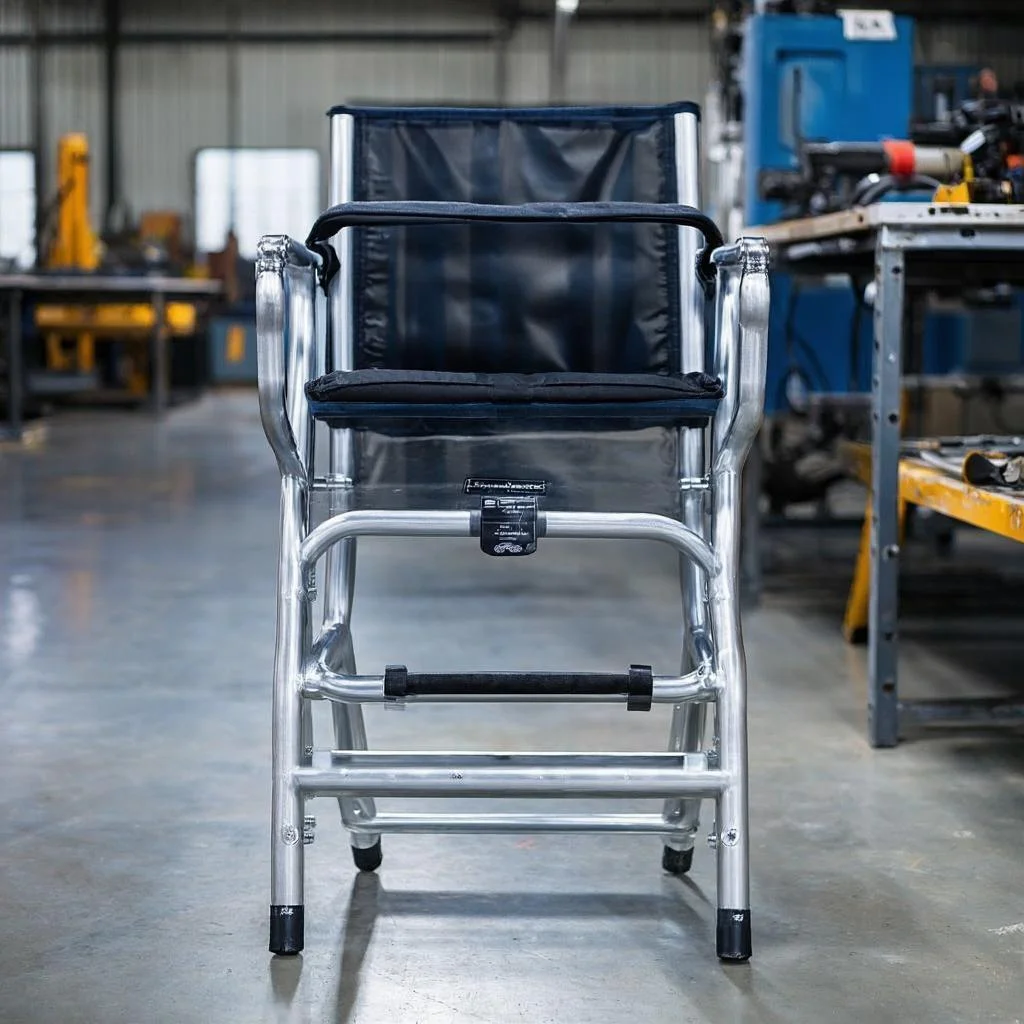
| Frame Spec | Budget (Skip This) | Commercial (Specify This) |
|---|---|---|
| Alloy | 6061, unreported temper | 6061-T6 or 7005-T6 |
| Raw tube wall | 1.0mm | 1.2mm minimum |
| Post-bend wall at weld points | Unmeasured | ≥1.2mm, verified by cross-section on first-off |
| Frame weight capacity | 100kg stated | 130kg tested (4-hour static load) |
| Diagonal cross-brace | None | Required on frames wider than 500mm |
What to write in your PO: "Frame alloy: 7005-T6 for chairs rated ≥130kg, 6061-T6 with minimum 1.2mm post-bend wall thickness at all weld points for chairs rated 100-130kg. Factory to provide cross-section measurement from first-off sample at every leg-to-frame junction."
Spec #2: Seat Foam Density and Compression Set Resistance
Spec #2 is invisible in a photograph. A chair fresh out of the box can have 18 kg/m³ foam and feel perfectly comfortable for the first three weekends.
By weekend twelve, the angler is sitting on what feels like the frame bar through a bedsheet. They do not file a warranty claim. They buy a different brand next season. You never know why you lost them.
Foam density is measured in kilograms per cubic metre. Every factory will say their foam is "high density." That phrase means nothing. Here are the numbers that matter:
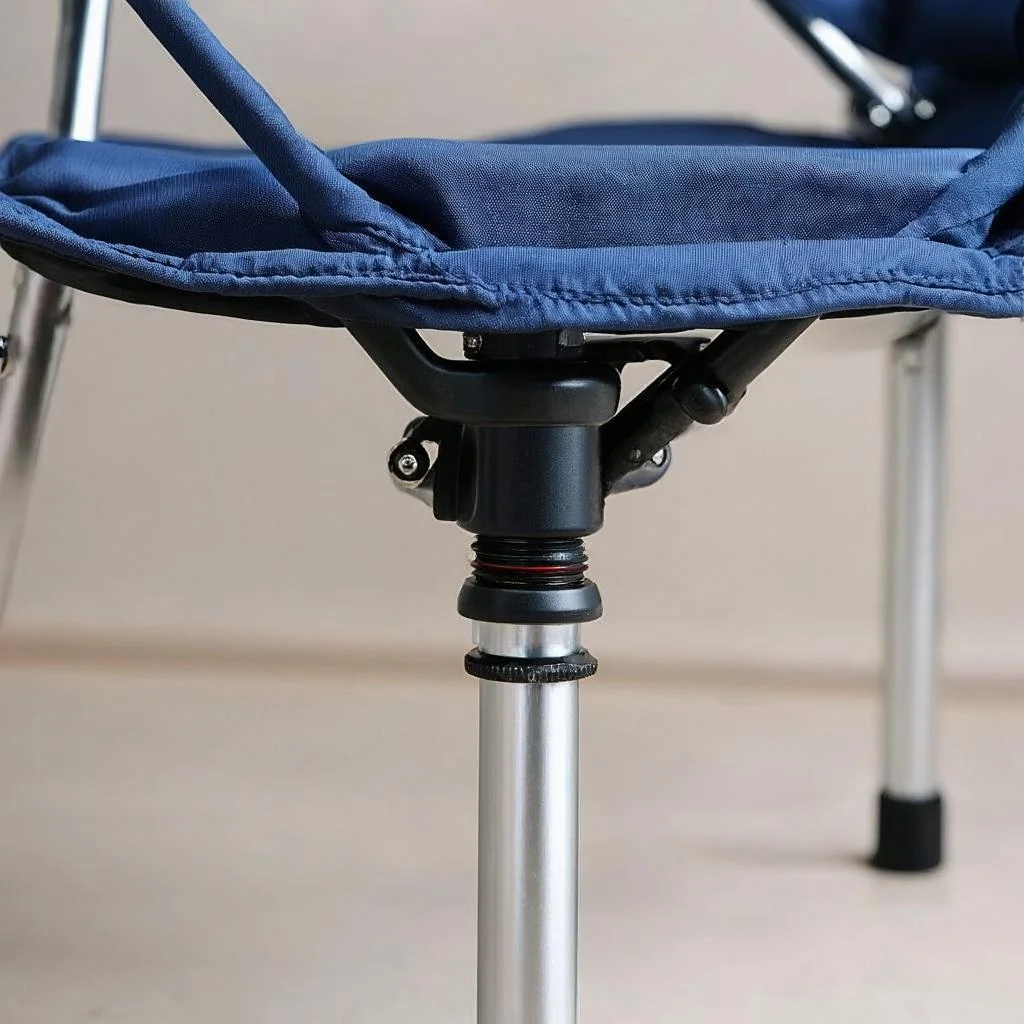
- Seat pad foam: Minimum 28 kg/m³. At 28, compression set stays under 10% for approximately 500 hours of use. At 22, the seat loses 30% of its thickness inside 200 hours.
- Armrest foam: Minimum 35 kg/m³. Point-load pressure from elbows compresses armrest foam three times faster than seat foam. At 28 kg/m³, armrests pancake within 8-10 weeks of regular use.
- Compression set resistance: Maximum 10% after 22 hours at 70°C, tested per ASTM D3574. This is the lab number that predicts real-world recovery. Foam that passes bounces back after every session.
We have seen factories substitute 18 kg/m³ foam to save approximately £0.80 per chair. On a 500-unit order, that saves £400 at the factory gate. The return rate on that order averages 11%. Sixty chairs come back.
Each return costs roughly £15 in shipping, handling, and replacement , £900 total. The £400 saving cost the buyer £900.
What to write in your PO: "Seat foam: minimum 28 kg/m³ density. Armrest foam: minimum 35 kg/m³ density. Compression set resistance: maximum 10% after 22h at 70°C (ASTM D3574). Factory to submit foam density test certificate per production batch."
Spec #3: Fabric Weave, Coating, and Finished Weight
A chair that sits on a UK bank for 200 hours across a season absorbs roughly 80 hours of direct UV, 15 hours of rainfall, and countless cycles of damp-to-dry transitions. The fabric is not decorative. It is the first and only barrier between the foam and the elements.
Most budget chair fabric is described as "600D Oxford." That description is incomplete in a way that costs buyers warranty claims. Here is the full specification language you need:
| Spec Element | Budget (Fails in 1 Season) | Commercial (Survives 3+ Seasons) |
|---|---|---|
| Weave construction | 600D×300D | 600D×600D |
| PU coating | Single pass, no UV stabiliser | Double pass with UV treatment |
| Finished weight | 180-220 g/m² | 280+ g/m² |
| Colour fastness | Grade 2-3 | Grade 4+ (ISO 105-B02) |
| Hydrostatic head | 800-1,200mm | 3,000mm+ |
The 600D×300D downgrade is the most common cost reduction. The factory uses a thinner weft yarn. Raw fabric cost drops roughly 25%. Tear strength drops nearly 40%. The PU coating has less substrate to bond to.
After one season of UV cycling, the coating delaminates from the base fabric. The chair looks like it has peeling sunburn.
What to write in your PO: "Fabric: 600D×600D Oxford weave, double-pass PU coating with UV stabiliser, minimum finished weight 280 g/m², colour fastness Grade 4 minimum per ISO 105-B02, hydrostatic head minimum 3,000mm. Factory to provide fabric specification sheet from the weaving mill."
If the factory cannot produce the mill spec sheet, they are buying commodity fabric. That means the fabric spec changes between production batches without anyone notifying you. Ask your manufacturer to specify the exact mill source. This is the same principle covered in our detailed factory audit guide.
Spec #4: Leg Lock Mechanism Tolerances and Load Testing
A leg lock failure is rarely dramatic. The chair does not collapse in a split second. One leg sinks by a single click over fifteen minutes. The angler feels the shift. They re-extend the leg.
Fifteen minutes later, it sinks again. After a two-hour session, they have re-adjusted three times. They do not file a warranty claim. They post a two-star review and buy a competitor's chair in March.
The root cause is always a tolerance stack-up. The locking pin is slightly undersized for the hole it must engage. Under sustained load, micro-movement becomes full disengagement.
The failure is invisible in standard QC because the inspector gives the legs a shake, hears the click, and ticks the box. What they do not do is put 120kg on the seat for four hours.
Here are the tolerances that prevent this failure:
- Outer tube inner diameter: 22.0mm ±0.05mm
- Inner tube outer diameter: 21.6mm ±0.05mm
- Clearance gap: 0.3-0.5mm (tight enough to prevent wobble, loose enough to telescope)
- Locking pin engagement depth: minimum 3mm into the locking hole
- Locking hole diameter: maximum 0.3mm oversize relative to pin diameter
The load test is the real enforcement mechanism. Require a 4-hour static load test at 150% of rated capacity on 5% of production units (AQL sampling). Zero leg movement allowed.
If one leg drops even one click, the entire batch fails. This is stricter than EN 581-2, which was written for patio furniture. Carp banks are not patios.
What to write in your PO: "Leg lock clearance gap: 0.3-0.5mm. Locking pin engagement: minimum 3mm. 4-hour static load test at 150% rated capacity on 5% AQL sample. Zero leg movement permitted. Go/no-go gauge inspection on 100% of locking mechanisms."
Spec #5: Armrest Construction and Padding , The Overlooked Comfort Killer
Armrests receive almost no attention on factory specification sheets. They deserve a dedicated section. Here is why.
An angler in a carp chair is not sitting upright at a desk. They are leaning slightly forward, rod in hand, watching a bite indicator. The armrests take continuous point-load pressure from elbows.
Over a four-hour session, that pressure repeatedly compresses the same square centimetres of foam. If the armrest frame underneath has sharp corners, the foam splits along the edge within weeks.
Three armrest specifications that prevent this:
- Frame edge radius: Minimum 3mm radius on all armrest frame edges that contact foam. A sharp 90-degree corner under 35 kg/m³ foam will still cut through after 100+ hours of use.
- Armrest foam density: 35 kg/m³ minimum, as noted in Spec #2. This is higher than the seat requirement because the load is far more concentrated.
- Armrest attachment: Bolted through the frame tube with a nylon locking nut, never a rivet. Riveted armrests develop play within 200 hours.
This is the counterintuitive point that surprises most buyers: armrest comfort drives more repeat purchases than seat comfort. An angler who notices their armrests have gone flat feels the degradation every time they put their elbows down.
The sensation is immediate and unpleasant. Seat foam degradation is gradual and harder to notice. The armrest complaint arrives first.
What to write in your PO: "Armrest frame edges: minimum 3mm radius at all foam-contact points. Armrest foam: minimum 35 kg/m³. Armrest attachment: M6 bolt with nylon locking nut through frame tube, not riveted."
Spec #6: Hardware Material Grades and Corrosion Protection
Corrosion is the failure that looks perfect on inspection day and generates warranty claims eighteen months later. The chair leaves the factory with shiny hardware. It sells. The angler uses it through a damp autumn.
They pack it away for winter. In March, the leg adjuster springs show rust. The folding mechanism binds. The customer emails you a photo.
Four hardware specifications prevent season-two corrosion claims:
- Steel hardware: 304 stainless steel. Do not accept "stainless steel" without the grade. 201 stainless looks identical to the naked eye. It rusts within 12 months of outdoor use. The cost difference is approximately £0.15 per chair.
- Aluminium-to-steel interfaces: Nylon washers at every point where a steel bolt contacts aluminium. Without the washer, galvanic corrosion pits the aluminium around the bolt hole within one season.
- Powder coating: Minimum 60µm thickness. Salt spray test certification per ISO 9227, minimum 240 hours to red rust. Budget powder coat at 30-40µm passes visual QC. It fails in the field.
- Leg adjuster springs: Zinc-plated spring steel or stainless. These sit at ground level in constant contact with mud and moisture. A rusted spring loses tension, and the leg lock from Spec #4 becomes impossible to hold.
What to write in your PO: "All steel hardware: 304 stainless grade only. Nylon isolation washers at all steel-to-aluminium interfaces. Powder coating: minimum 60µm thickness, ISO 9227 salt spray minimum 240h to red rust. Leg adjuster springs: zinc-plated spring steel or 304 stainless."
These four items add roughly £0.40 to factory cost per chair. The warranty claim they prevent costs far more. For a deeper analysis of how these failure points generate returns, read our full failure analysis guide.
Spec #7: Dimensional Geometry and Frame Flatness
A chair can pass every material specification and still feel wrong. That "wrong" feeling is almost always a frame flatness issue. The four leg contact points do not sit in a perfectly flat plane.
On hard ground, a twisted frame rocks between two diagonal legs. On soft ground, the rock disappears into the mud , but the frame is now under constant torsional stress.
That stress accelerates fatigue at the weld points covered in Spec #1. The chair fails sooner. The failure gets blamed on weld quality when the real problem is geometry.
Two causes produce frame twist:
- Welding jig misalignment: The jig is off by 1-2 degrees. Over a 500mm frame width, that creates a 9-17mm leg height discrepancy. The chair rocks. Always.
- Tube straightness variance: Aluminium extrusion tolerances allow up to 1mm of bow per metre. If the factory does not straighten tubes before welding, the finished frame inherits that bow.
What to write in your PO: "Frame flatness tolerance: ±1.5mm corner-to-corner, measured diagonally on a granite surface plate. Factory to measure 5 random frames per production batch and provide flatness values. Any frame exceeding ±2mm flatness fails and requires jig recalibration."
This is the least-requested specification across the entire industry. We estimate fewer than 10% of OEM buyers include a flatness tolerance in their purchase orders.
It is also the specification that correlates most strongly with user satisfaction scores, because anglers cannot identify a twisted frame. They can only feel that the chair is "uncomfortable" and buy a different one.
The Complete 7-Point OEM Specification Sheet
Copy these seven lines into your next purchase order. Make them non-negotiable. Require verification for each line before the factory runs production.
| # | Specification Point | Required Value | Verification |
|---|---|---|---|
| 1 | Frame alloy and wall | 7005-T6 (≥130kg rated) or 6061-T6 (100-130kg); post-bend wall ≥1.2mm at all weld points | Cross-section measurement on first-off sample |
| 2 | Foam density | Seat ≥28 kg/m³; armrest ≥35 kg/m³; compression set ≤10% (ASTM D3574) | Density test certificate per production batch |
| 3 | Fabric | 600D×600D Oxford; double-pass PU with UV stabiliser; ≥280 g/m²; colour fastness Grade 4+; hydrostatic head ≥3,000mm | Mill fabric specification sheet |
| 4 | Leg lock tolerances | Clearance gap 0.3-0.5mm; pin engagement ≥3mm; 4h static load at 150% rated capacity | Go/no-go gauge on 100%; AQL 5% load test |
| 5 | Armrest engineering | Frame edge radius ≥3mm; foam ≥35 kg/m³; M6 bolt + nylon lock nut (not riveted) | Visual inspection on first-off; batch AQL |
| 6 | Hardware and corrosion | 304 stainless hardware; nylon washers at steel-Al interfaces; powder coat ≥60µm, ISO 9227 240h | Material certs; coating thickness gauge; salt spray cert |
| 7 | Frame flatness | ±1.5mm corner-to-corner on granite surface plate | Measurement of 5 random frames per batch |
A chair built to these seven specifications costs roughly £4.00-6.00 more at factory gate than a chair built to the unwritten standards most factories default to.
On a chair with an FOB price of £22, that represents an 18-27% cost increase.
The chair also generates close to zero warranty claims, zero negative reviews mentioning quality, and repeat orders from retailers who do not spend their Mondays processing returns. The ROI lives in the silence of your customer service inbox.
At AnglinGear, we apply these seven specifications to every carp fishing chair in our catalogue. We verify them at the factory before production starts. We inspect against them at the packing line. We stand behind them after delivery.
A specification sheet is only as good as the inspection that enforces it.
Sources & Industry References
- Carpology Magazine , Leading European publication for carp fishing gear reviews and industry news
- International Game Fish Association (IGFA) , World records, fishing standards, and angling regulations
- Statista: Fishing Industry Data , Market size, trends, and consumer spending on fishing equipment
Sources & Industry References
- Carpology Magazine , Leading European publication for carp fishing gear reviews and industry news
- International Game Fish Association (IGFA) , World records, fishing standards, and angling regulations
- Statista: Fishing Industry Data , Market size, trends, and consumer spending on fishing equipment
Ready to Transform Your Wholesale Feeder Chair Procurement Strategy?
Let us show you how compliance, quality, and sustainability can drive your commercial success.
Request Partner Information Pack(This is a living document and will be updated to reflect changes in industry regulations and supply chain best practices.)