Author's Note: This guide is built from engineering data, factory inspection records, and commercial-grade material specifications used across OEM production lines.
It is designed for procurement professionals who need to evaluate material choices , not marketing claims , when sourcing carp fishing chairs at wholesale scale.
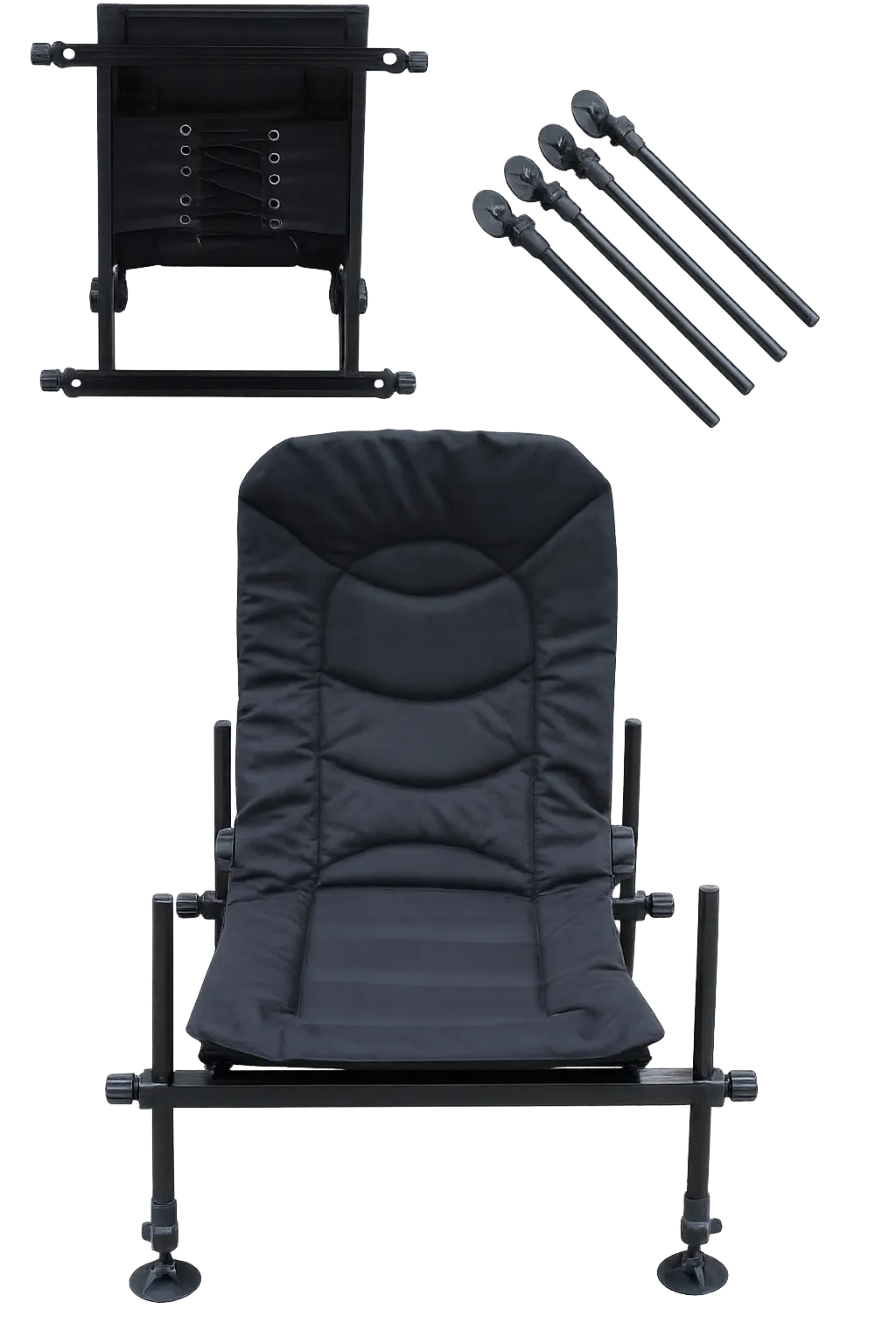
A carp fishing chair is constructed from four core material systems: the structural frame (aluminium alloy or powder-coated steel), the seating fabric (600D Oxford (found in products like our Heavy Duty Fishing Chair) polyester with PU or PVC coating), the cushioning layer (high-density polyurethane foam, EVA foam, or memory foam), and the hardware assembly (stainless steel bolts, riveted joints, and rubber/TPE mud feet).
In the B2B procurement context, the question "what is a carp fishing chair made of" is not about a single answer , it is about a specification stack that directly determines your product's weight capacity, warranty liability, container-load freight cost, and retail margin structure.
The global fishing equipment market was valued at USD 21.96 billion in 2024 and is projected to grow at a CAGR of 3.0% to 3.78% through 2030–2035 (Source: Grand View Research, 2025; Source: Market Research Future, 2025).
Within this expanding market, material specification is the single largest differentiator between a chair that generates repeat wholesale orders and one that triggers warranty claims by its second season.
Table of Contents
- 1. Frame Materials: The Structural Foundation
- 2. Fabric Systems: Oxford Polyester and Coating Technologies
- 3. Foam and Padding: Density, Type, and Long-Term Performance
- 4. Leg Systems, Mud Feet, and Adjustment Mechanisms
- 5. Hardware, Fasteners, and Assembly Components
- 6. Material Comparison Table for B2B Decision-Making
- 7. OEM Material Specification Checklist
Frame Materials: The Structural Foundation
The frame is the single most consequential material decision in carp fishing chair procurement.
It governs weight capacity, portability, corrosion resistance, and product lifespan , and it accounts for roughly 40–55% of the chair's total bill of materials (BOM) cost at factory level.
Aluminium Alloy Frames: The Premium Standard
6061 aluminium alloy is the dominant material in mid-to-premium carp fishing chairs. It offers a strength-to-weight ratio that steel cannot match in portable applications.
A fully assembled 6061 aluminium chair frame typically weighs 3.0–4.5 kg, compared to 5.5–7.5 kg for an equivalent steel frame (Source: ChairsForCamping frame weight analysis).
This weight delta translates directly into lower freight costs per container , a material advantage when shipping 40HQ containers with 800–1,200 chair units.
Within the aluminium family, two alloy series dominate:
- 6000-series (6061, 6063): The workhorse alloy. Magnesium-silicon composition. Excellent corrosion resistance without coating. Typical yield strength: 240–276 MPa in T6 temper. Wall thickness for commercial-grade chair tubing: 1.2 mm minimum. Widely available from Chinese extrusion mills, keeping raw material costs predictable for OEM programs.
- 7000-series (7005, 7075): Aircraft-grade alloy with zinc as the primary alloying element. Yield strength can exceed 500 MPa in T6 temper , approaching mild steel levels at roughly 60% of the weight. Used in ultra-lightweight premium chairs but commands a 2–3× material cost premium over 6061. This series is harder to weld and requires specialized heat treatment post-welding, adding manufacturing complexity.
For B2B importers, the practical specification rule is straightforward: 6061-T6 with 1.2 mm minimum wall thickness delivers the optimal balance of cost, strength, and corrosion resistance for the European and North American retail channels.
A 7000-series frame is only commercially justifiable when targeting the ultralight segment with retail price points above €150.
Steel Frames: The Cost-Driven Option
Steel frames use Q195 or Q235 carbon steel tubing, typically 22–25 mm diameter with 1.0–1.5 mm wall thickness.
Steel's higher density provides inherent stability , a steel-frame chair feels "planted" on uneven terrain, which some end-users prefer.
Weight capacity on well-engineered steel frames can reach 150–200 kg, compared to 130–170 kg for equivalent aluminium designs.
However, steel introduces a critical vulnerability: corrosion. Every steel carp chair frame must be powder-coated or electrophoretically coated.
The quality of this coating , not the underlying steel , determines whether the chair survives multiple seasons of bankside dew, rain, and mud exposure.
When the coating chips at weld points or adjustment joints, rust propagation begins within weeks in humid environments.
This is the single most common failure mode reported by European distributors for budget steel-frame chairs (Source: FAIRWIND B2B frame analysis).
Procurement insight: When evaluating a steel-frame manufacturer, request a salt-spray test report (ASTM B117 or ISO 9227) for the coated frame , not just the raw material certificate.
A frame that survives 500+ hours of neutral salt spray without red rust is suitable for multi-season use. Anything below 200 hours will generate warranty claims in coastal or humid markets.
Fabric Systems: Oxford Polyester and Coating Technologies
The seating surface of a carp fishing chair is almost universally made from Oxford-weave polyester fabric.
The Oxford weave , characterized by its distinctive basket-weave structure with interlocking warp and weft yarns , provides a balance of tensile strength, abrasion resistance, and controlled stretch that flat-woven polyester cannot match.
In the B2B supply chain, "Oxford fabric" is not one material , it is a specification stack defined by denier, coating chemistry, GSM weight, and UV stabilization treatment.
Denier: The Primary Strength Metric
Denier (D) measures the linear mass density of the yarn. Higher denier = thicker, heavier, stronger yarn. In carp fishing chair production:
- 300D Oxford: Lightweight, used in budget compact chairs and accessory pouches. Tear strength is insufficient for load-bearing seat panels on chairs rated above 100 kg.
- 600D Oxford: The commercial sweet spot. Balances strength, weight (180–230 GSM for PU-coated, 350–550 GSM for PVC-coated), and cost. Used by approximately 80% of mid-market carp chair manufacturers. A properly constructed 600D PU-coated seat panel can withstand 20,000+ Martindale abrasion cycles (Source: Feistel Outdoor 600D technical analysis).
- 900D and 1200D Oxford: Heavy-duty fabrics used in premium fixed-location chairs and bedchairs. Tear strength is 40–60% higher than 600D, but the additional weight (300–450+ GSM) increases freight cost and chair portability , a relevant trade-off for product positioning.
PU vs PVC Coating: The Critical Distinction
The coating applied to the Oxford fabric determines water resistance, UV durability, hand-feel, and , critically , chair weight. This distinction is frequently overlooked in B2B negotiations, yet it directly impacts retail customer satisfaction:
- PU (Polyurethane) Coating: Applied at 180–230 GSM, PU creates a flexible, breathable waterproof barrier. ISO 811 hydrostatic resistance typically reaches 8,000–10,000 mm. PU-coated fabric is lighter and softer to the touch, making it the preferred choice for portable and mid-weight chairs. UV resistance: 500+ hours under ISO 4892-2 xenon-arc testing for quality grades.
- PVC (Polyvinyl Chloride) Coating: Applied at 350–550 GSM, PVC creates a heavier, stiffer, completely impermeable barrier. More durable against abrasion and easier to wipe clean. Preferred for fixed-location chairs, rental fleets, and institutional buyers. The trade-off: PVC-coated chairs weigh 1.0–1.8 kg more than equivalent PU-coated models, impacting both end-user portability and container-load economics.
Specification takeaway: A B2B purchase order that states only "600D Oxford fabric" is underspecified.
The order should define: denier (600D), coating type (PU), GSM range (180–230), and UV treatment (UPF 50+ or ISO 4892-2 ≥ 500h).
Without these parameters, two manufacturers can quote the same "600D Oxford" and deliver materially different fabric performance , one that lasts five seasons, another that sags and fades after one summer.
Foam and Padding: Density, Type, and Long-Term Performance
Foam padding is the component most directly felt by the end-user , and the component most likely to generate subjective complaints when it fails.
In B2B procurement, foam specification is governed by one metric above all others: density (kg/m³), not thickness.
A 50 mm layer of 20 kg/m³ foam will collapse to a flat membrane within 6–12 months of regular use.
A 30 mm layer of 40 kg/m³ foam will retain its cushioning profile for 3–5 years. The difference is compression set , and it is measurable.
Three Foam Types in Commercial Use
- High-Density Polyurethane (PU) Foam (25–35 kg/m³): The standard padding material for mid-market carp chairs. Open-cell structure provides good initial comfort. At 25 kg/m³ density, expect 18–24 months of acceptable performance before noticeable compression. At 35 kg/m³, service life extends to 3–4 years. This is the most cost-effective option for standard retail channels.
- EVA Foam (33–280 kg/m³): Closed-cell ethylene-vinyl acetate foam. Zero water absorption , a critical advantage for chairs used in wet conditions. EVA at 60–80 kg/m³ provides a firm, supportive seat suitable for anglers who prioritize posture over plushness. EVA is also inherently UV-resistant and does not degrade from repeated wet-dry cycles the way open-cell PU foam does. Common in premium and specialist chairs targeting the European winter carp market (Source: Foam Spirit EVA material analysis).
- Memory Foam (Viscoelastic PU, 50+ kg/m³ density): The premium comfort option. Conforms to body shape under heat and pressure, then slowly returns to original form. Used in high-end chairs and bedchairs for the long-session angler. Memory foam at 50 density (50 kg/m³) is the benchmark for products positioned at retail prices above €120. Below 40 density, memory foam loses its viscoelastic properties and performs similarly to standard PU foam , making the "memory foam" label a marketing term rather than a functional advantage.
B2B specification rule: When issuing an OEM RFQ for foam-padded chairs, specify foam type + density in kg/m³ + thickness in mm.
Example: "PU foam, 35 kg/m³ minimum density, 40 mm seat thickness, 25 mm backrest thickness." A manufacturer who cannot provide density data is a manufacturer who does not control their foam input quality , and that becomes your warranty exposure.
Leg Systems, Mud Feet, and Adjustment Mechanisms
The leg system of a carp fishing chair is where material engineering meets terrain reality.
A chair that is stable on a showroom floor can become unusable on a muddy, sloped riverbank if the leg materials and adjustment mechanism are under-specified.
Leg Tube Materials
Leg tubes are typically aluminium (same alloy as frame) or steel, with outer diameters of 22–25 mm for the outer tube and 19–22 mm for the inner telescoping section.
Aluminium legs save 0.8–1.5 kg per chair compared to steel legs , a meaningful weight reduction for portable models. The telescoping mechanism uses a spring-loaded pin (spring-loc) or a twist-lock collar.
Spring-loc mechanisms with stainless steel pins are more reliable than plastic twist-locks, which can crack under lateral load on uneven ground.
Mud Feet: Small Component, Large Impact
Mud feet are the chair's ground-contact points. They must prevent sinking on soft ground while allowing angular adjustment on slopes. Three materials are standard:
- TPE (Thermoplastic Elastomer): The premium option. Flexible at low temperatures (down to -20°C), good grip on wet surfaces, and UV-resistant. Used in chairs positioned above the €80 retail threshold.
- PVC: Cheaper than TPE, adequate for moderate climates, but can become brittle below 0°C , a genuine failure risk for winter carp fishing in Northern Europe.
- Rubber (NR/SBR): Excellent grip but heavier and can degrade from UV exposure if not properly compounded with carbon black and anti-oxidants. Common in budget chairs where cost is the primary constraint.
The mud foot diameter matters as much as the material. A 70 mm foot provides approximately 2.5× the ground-contact area of a 45 mm foot, dramatically reducing sinkage on soft terrain.
For the European market where clay-bank fishing is common, specify mud feet with a minimum 65 mm diameter.
Hardware, Fasteners, and Assembly Components
The hardware layer , bolts, rivets, washers, armrest pivots, and backrest adjustment ratchets , is the least visible material system in a carp fishing chair. It is also the most common point of mechanical failure.
A chair that "collapsed" almost always failed at a fastener or joint, not at the frame tube or fabric.
Fastener Specifications
- Bolts: M6 and M8 stainless steel (304 or 316 grade) with Nyloc nuts are the commercial standard for load-bearing joints. Zinc-plated carbon steel bolts cost 60–70% less but will corrode within 12–18 months of outdoor exposure , a hidden defect that transforms into visible rust stains on the fabric. For any chair targeting a retail price above €50, 304 stainless steel fasteners should be a non-negotiable specification.
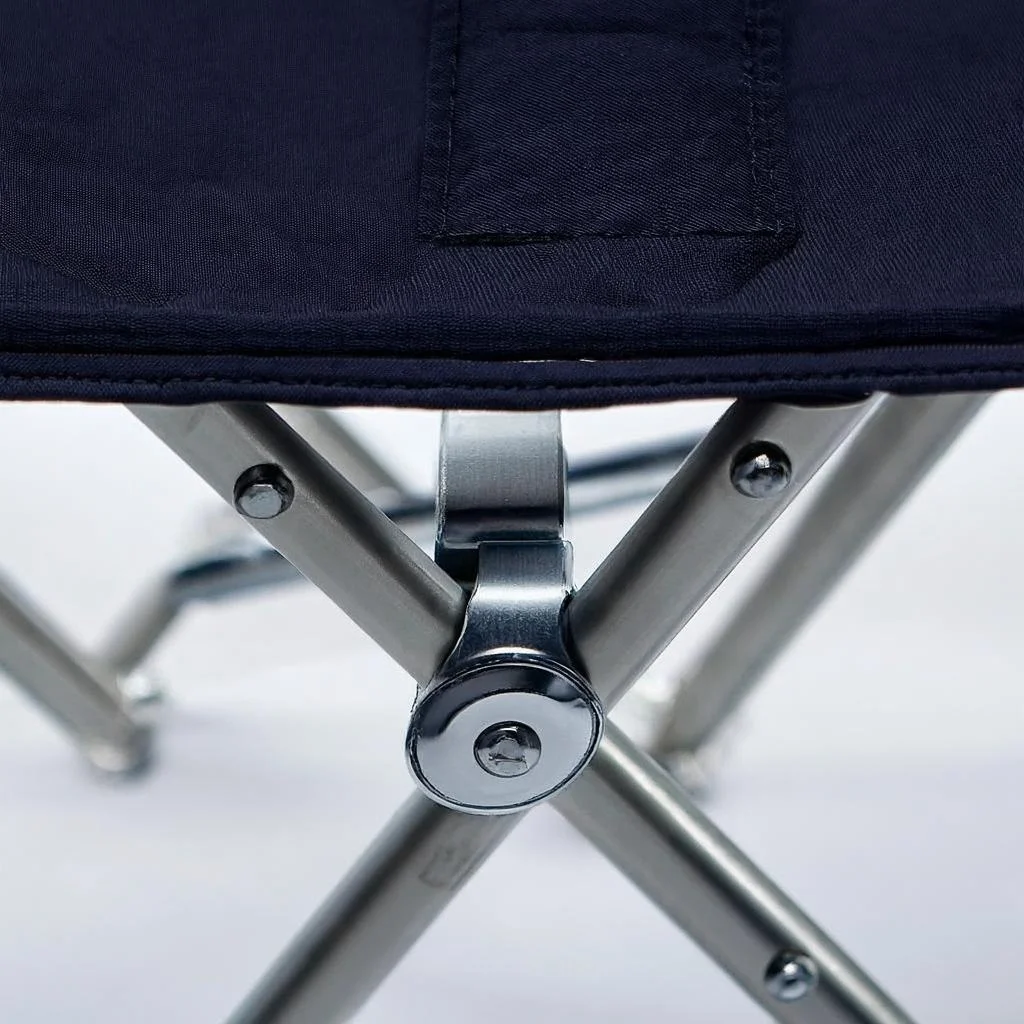
- Rivets: Blind aluminium rivets with steel mandrels are standard. For high-stress pivot points (armrest hinges, backrest adjustment), specify stainless steel rivets with a minimum shear strength of 3.5 kN.
- Armrests: EVA foam-wrapped aluminium tubing or injection-moulded PP (polypropylene) with a textured grip surface. PP armrests are cheaper but can crack on impact if the polymer is not UV-stabilized. For OEM orders, request the PP grade specification , PP-H or PP-C (copolymer) with UV stabilizer additive.
Welded vs bolted construction: The industry is split between fully welded frames (stronger, fewer failure points, but harder to repair) and bolted modular frames (repairable, replaceable components, but more assembly points to inspect).
For the importer, modular bolted construction enables spare-parts programs , a commercial advantage for distributors who want to offer after-sales service rather than full-unit replacements.
Material Comparison Table for B2B Decision-Making
The following table summarizes the key material choices across the carp fishing chair specification stack.
Use this as a reference when evaluating manufacturer quotations , the material line items in a factory BOM directly translate to the performance your retail customers will experience.
| Component | Budget Specification | Mid-Market Specification | Premium Specification | Key Performance Delta |
|---|---|---|---|---|
| Frame Material | Q195 steel, 1.0mm wall, powder-coated | 6061-T6 aluminium, 1.2mm wall | 7005-T6 aluminium, 1.5mm wall | Weight: 7.5kg → 3.5kg → 2.8kg. Corrosion: coating-dependent → inherent resistance → aircraft-grade |
| Seat Fabric | 600D Oxford, PVC-coated, 350 GSM | 600D Oxford, PU-coated, 200 GSM, UV-stabilized | 900D Oxford, PU-coated, 300 GSM, UPF 50+ | Abrasion cycles: ~10,000 → 20,000+ → 30,000+. Chair weight penalty: +1.5kg → +0.3kg → +0.6kg |
| Foam Padding | PU foam, 20–25 kg/m³, 30mm | PU foam, 30–35 kg/m³, 40mm | EVA 80 kg/m³ or Memory Foam 50D, 40mm | Service life before compression: 12–18 months → 36–48 months → 60+ months |
| Leg System | Steel tubes, PVC mud feet, plastic lock | Aluminium tubes, TPE mud feet (65mm), spring-loc steel pin | Oval aluminium tubes, TPE swivel feet (80mm), spring-loc 304SS pin | Cold-weather reliability: brittle below 0°C → reliable to -20°C → reliable to -30°C |
| Fasteners | Zinc-plated carbon steel M6/M8 | 304 stainless steel M6/M8, Nyloc nuts | 316 stainless steel M8, Nyloc nuts, SS rivets at pivots | Corrosion-free service: 12 months → 5+ years → 10+ years |
| Armrests | Injection PP, smooth finish | EVA-wrapped aluminium, textured grip | Neoprene-covered aluminium, ergonomic contour | Comfort perception: basic → good → premium. UV degradation: 2 years → 5 years → 8+ years |
| Est. Ex-Factory Unit Cost | $18–28 | $30–50 | $55–85+ | Retail price floor (2.5× markup): €45 → €75 → €140 |
Note: Ex-factory costs are indicative ranges based on MOQ 300–500 units with standard colours and packaging. Custom powder-coat colours, branded embroidery, and premium packaging add 8–15% to the base BOM cost.
OEM Material Specification Checklist for B2B Importers
When engaging a carp fishing chair factory for OEM or ODM production, the following material specifications should be documented in your purchase contract or technical annex.
A manufacturer who can confirm every line item with test data is a manufacturer who controls their material inputs. A manufacturer who cannot is relying on their sub-manufacturers , and passing that risk to you.
| Material Category | Specification to Request | Acceptance Threshold | Test Standard |
|---|---|---|---|
| Aluminium Frame | Alloy grade, temper, wall thickness, weld inspection | 6061-T6, ≥1.2mm wall, no visible weld porosity | Manufacturer mill certificate + visual weld inspection |
| Steel Frame | Steel grade, coating type, salt-spray resistance | Q195/Q235, powder coat, ≥500h ASTM B117 no red rust | ASTM B117 / ISO 9227 |
| Oxford Fabric | Denier, coating type, GSM, UV treatment | 600D, PU-coated, 180–230 GSM, ISO 4892-2 ≥500h | ISO 4892-2 / AATCC 16 |
| Foam Padding | Foam type, density (kg/m³), thickness, compression set | PU ≥35 kg/m³ or EVA ≥60 kg/m³, compression set ≤10% | ASTM D3574 / ISO 1856 |
| Fasteners | Material grade, coating, torque specification | 304 SS for all load-bearing joints, Nyloc nuts | Manufacturer grade certificate |
| Mud Feet | Material, diameter, cold-temperature flexibility | TPE ≥65mm, no cracking at -20°C | Visual inspection at specified temperature |
Market Context: Why Material Specification Matters Now
The European recreational fishing equipment market , the primary destination for most B2B carp chair imports , is experiencing two structural shifts that elevate the importance of material specification.
First, EU consumer protection regulations (GPSD and the proposed GPSR) increasingly require importers to demonstrate product safety through documented material specifications, not just final-product CE marking.
A chair that injures a user because a zinc-plated bolt sheared after corrosion will trace liability directly to the importer who accepted an under-specified fastener (Source: EU CE Marking Guidelines).
Second, the carbon footprint disclosure trend , already mandatory for large EU importers under CSRD , is pushing material traceability from a "nice to have" to a "license to supply." An aluminium frame made from 60% post-consumer recycled content carries a materially different carbon footprint than one made from 100% primary smelter aluminium.
Importers who can document their material sustainability credentials will have preferential access to the growing segment of European retailers with ESG procurement policies.
The global fishing equipment market, projected to reach USD 26.32–31.19 billion by 2030–2035 depending on the research source (Source: Grand View Research; Source: Market Research Future), rewards manufacturers who invest in material quality.
The cost of replacing warranty-returned chairs , including reverse logistics, customer service overhead, and brand reputation damage , is typically 3–5× the unit-cost saving from downgrading a material specification.
In B2B carp chair procurement, the cheapest material is almost never the cheapest chair.
Conclusion: Material Specification as Competitive Advantage
Understanding what a carp fishing chair is made of is not a product-trivia exercise. It is the foundation of your procurement strategy.
Every material choice , 6061 vs Q195, PU vs PVC, 35 kg/m³ vs 20 kg/m³ foam, 304 SS vs zinc-plated fasteners , represents a commercial decision about your brand's market positioning, your warranty liability exposure, and your relationship with the retail buyers who will stock your products.
The importers who win in the 2026–2030 fishing equipment market will not be those who find the lowest unit price.
They will be those who can walk into a retail buyer's office and answer the question "what is this chair made of" with engineering specificity , backed by manufacturer test data, not marketing adjectives.
This guide is designed to give you that capability.
Sources & Industry References
- Grand View Research: Fishing Apparel & Equipment Market Report , Global market size of USD 21.96 billion (2024), projected CAGR 3.0% to 2030
- Market Research Future: Fishing Equipment Market Analysis , Market valued at USD 20.74 billion (2024), projected to reach USD 31.19 billion by 2035 at CAGR 3.78%
- Feistel Outdoor: 600D Oxford Fabric Explained , Technical analysis of denier ratings, PU vs PVC coatings, GSM ranges, and UV resistance for outdoor chair fabrics
- FAIRWIND: Aluminum vs Steel Camping Chair , Cost, Durability, and Market Fit , B2B frame material comparison covering corrosion, weight, and sourcing strategy
- ChairsForCamping: Steel vs Aluminum Camping Chairs , Frame weight comparison data and alloy series analysis
- Foam Spirit: EVA Foam Material Overview , Density ranges, Shore hardness, and water-resistance properties of EVA foam
- Six Dragon Textile: Polyester Oxford Fabric , Manufacturing specs including ISO 811 hydrostatic resistance and ISO 4892-2 UV testing for Oxford fabric
Ready to Specify Your Next Carp Fishing Chair Order?
We provide complete material specification dossiers , alloy certificates, fabric test reports, foam density data, and salt-spray results , with every OEM quotation. Let us show you what your chairs will be made of before you place the order.
Request Material Specification Dossier(This material specification guide is reviewed quarterly to reflect changes in industry standards, alloy availability, and regulatory requirements. Last updated: June 2026.)